



Turbochargers for cars with AHF and ALH engines
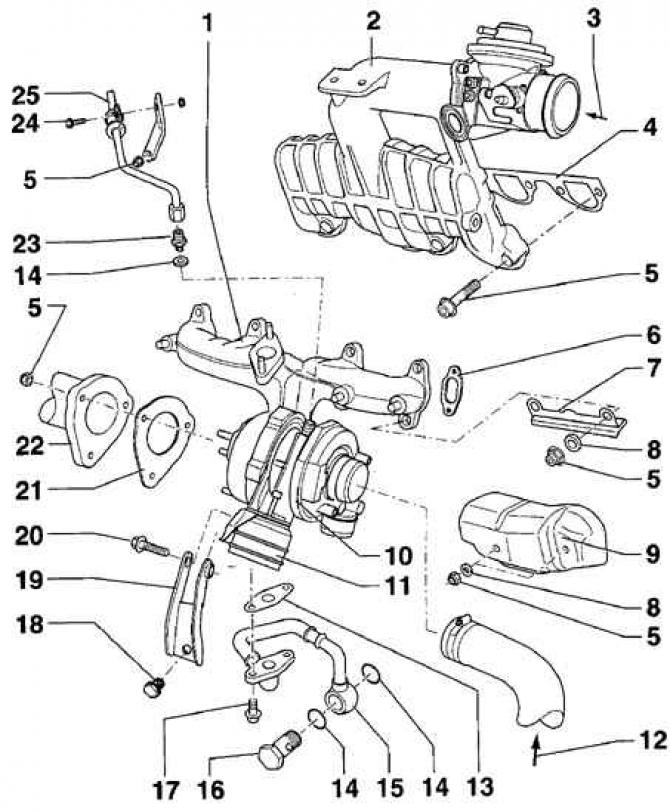
- 1 - exhaust manifold;
- 2 - intake manifold;
- 3 - from the supercharged air radiator;
- 4 - Seal. A new seal must be used during installation;
- 5 - bolt; 25 Nm;
- 6 - Seal. Observe the installation position of the seal;
- 7 - bracket;
- 8 - washer;
- 9 - screen;
- 10 - turbocharger. When removing the turbocharger, first remove the right drive shaft;
- 11 - pressure box;
- 12 - from the air filter;
- 13 - Seal. A new seal must be used during installation;
- 14 - O-ring. A new O-ring must be used during installation;
- 15 - oil supply pipeline;
- 16 - hollow bolt, 40 Nm;
- 17 - bolt, 15 Nm;
- 18 - bolt, 40 Nm;
- 19 - bracket;
- 20 - bolt, 25 Nm;
- 21 - Seal. A new seal must be used during installation;
- 22 - exhaust inlet pipe;
- 23 - connecting nipples;
- 24 - bolt, 10 Nm;
- 25 - oil drain pipe
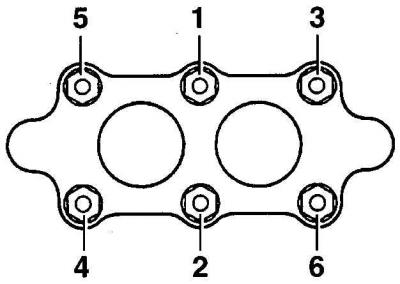
Tightening sequence of the exhaust pipe to exhaust manifold mounting bolts on a non-turbocharged engine
Removal
The exhaust system can be removed either as a whole or in separate sections.
1. Raise the vehicle and support it on stands. Remove the lower engine compartment splash guard.
2. Apply a rust destroying agent to the nuts and bolts that fasten the exhaust system components. Wait for some time until the rust is completely destroyed.
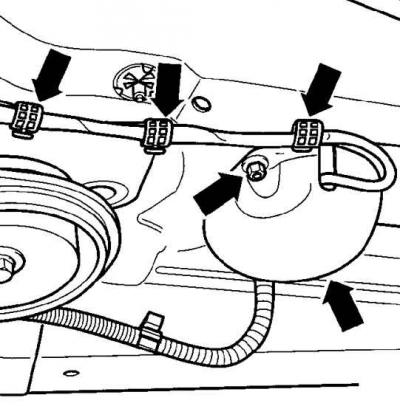
3. Unscrew the cover covering the electrical connector of the lambda sensor (two lower arrows).
4. Release the lambda sensor wire from the clamps on the heat shield (top arrows).
5. Disconnect the lambda sensor electrical connector.
6. On all-wheel drive models and models with a 1.6-I engine with an automatic transmission, the lambda sensor is installed in the exhaust manifold and it is not necessary to disconnect the lambda sensor electrical connector.
7. On models with 1.4-I engines, the lambda sensor is installed in front near the sealing gasket of the exhaust inlet pipe flange.
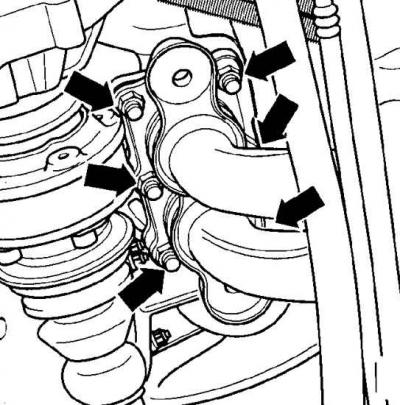
8. Unscrew the exhaust pipe from the exhaust manifold from below (the fastening nuts are indicated by arrows).
9. Support the exhaust system by tying it to the bottom of the car with wire.
10. Unbolt the front section of the exhaust system from the front cross member.
The original information is posted on the resource [www.VWMANUAL.ru]
11. Loosen the clamps and remove the exhaust system.
Installation
1. To make it easier to unscrew the nuts and bolts securing the exhaust system, lubricate them with Liqui Moly LM-508-ASC high-temperature paste.
2. Before reconnecting the exhaust system components, clean their connections with sandpaper to remove any remaining sealant or rust.
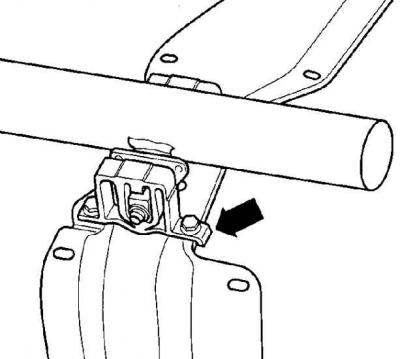
3. Attach the exhaust brackets to the front crossmember so that the beveled side (shown by arrow) was directed towards the front of the car.
4. Install the exhaust system components into the rubber mounts.
5. Tighten the exhaust system bracket mounting bolts to the front beam to 25 Nm.
Engines without turbocharger
6. Connect the exhaust pipe with a new gasket to the exhaust manifold and tighten the mounting bolts in the sequence shown in the figure Tightening sequence of the exhaust pipe mounting bolts to the exhaust manifold on an engine without a turbocharger, to a torque of 40 Nm.
Engines with turbocharger
7. Connect the exhaust manifold with a new gasket to the turbocharger and tighten the mounting bolts crosswise to 40 Nm.
8. If necessary, rotate the exhaust system sections so that the entire exhaust system is located at the same distance from the body.
9. Finally tighten all nuts and bolts securing the exhaust system.
10. Install the lower engine compartment splash shield.
11. Secure the lambda sensor wire with spring clips. Connect the lambda sensor electrical connector and cover it with the casing.
12. Start the engine and check the exhaust system for leaks.
Tightening moments
| Exhaust manifold to cylinder head | 25 Nm |
| Clamps securing exhaust pipe connections | 40 Nm |
| Exhaust inlet pipe to manifold | 40 Nm |
| Fastening exhaust pipes to the branch of the exhaust system | 25 Nm |
| Lambda sensor to catalytic converter | 50 Nm |
Visitor comments