



Contents: Removal ↓ Installation ↓
Exhaust Gas Recirculation System on SDI Diesel Models
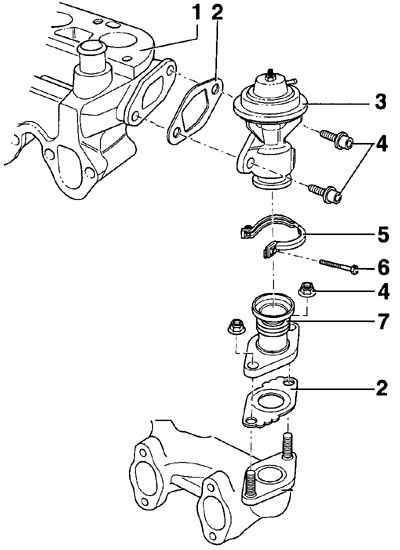
- 1 - lower part of the intake manifold;
- 2 - Seal. A new seal must be used during installation;
- 3 - recirculation system valve;
- 4 - bolt, 25 Nm;
- 5 - clamp bracket;
- 6 - bolt, 10 Nm;
- 7 - connecting pipe
Exhaust gas recirculation system on vehicles with TDI diesel engines
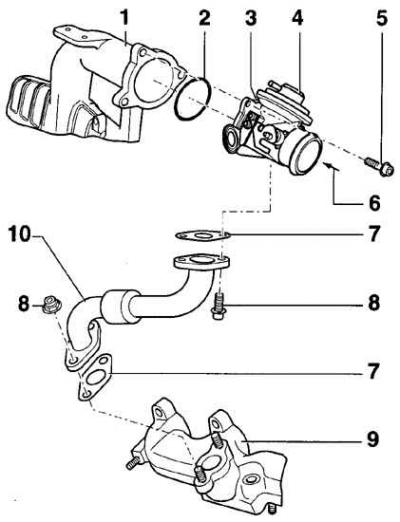
- 1 - intake manifold;
- 2 - O-ring with round cross-section. A new O-ring must be used during installation;
- 3 - suction pipe;
- 4 - exhaust gas recirculation valve;
- 5 - bolt, 10 Nm;
- 6 - from the supercharged air radiator;
- 7 - Seal. A new seal must be used during installation;
- 8 - nut, 25 Nm;
- 9 - exhaust manifold;
- 10 - connecting pipe
The lambda sensor is used to regulate the composition of exhaust gases in cars with gasoline engines and is screwed into the exhaust pipe near the catalytic converter.
Removal
1. Raise the car and secure it on stands. Remove the protective cover near the catalytic converter, covering the electrical connector of the lambda sensor. Release the lambda sensor wire from the mounting brackets (see the figure in paragraph 3 of subsection 5.2). On all-wheel drive models and models with a 1.6-I engine with an automatic transmission, the lambda sensor is installed in the exhaust manifold. On models with a 1.4-I engine, the lambda sensor is installed in front near the sealing gasket of the exhaust inlet pipe flange.
2. Using a wrench, unscrew the lambda sensor from the exhaust inlet pipe.
Installation
1. Apply a thin layer of G5 grease to the lambda sensor threads.
2. When installing a new lambda sensor, there is already grease on its threads. Do not lubricate the working part of the lambda sensor.
3. Screw the lambda sensor into the exhaust pipe and tighten it to 50 Nm.
4. Connect the electrical connector to the lambda sensor and secure the electrical connector wire. Cover the electrical connector with a protective cover.
5. Lower the car.
Visitor comments