



The engine or gearbox mounts are faulty, or the mounting bolts are loose. This means that the drive mechanism begins to wobble when the clutch is engaged.
The clutch linings on the driven disk have burnt or hardened, meaning that uniform friction between the clutch and the flywheel is impossible. This can happen if, for example, another vehicle has been towing over a long distance.
The pressure plate has become warped due to strong heat build-up, meaning the friction surface is no longer perfectly smooth.
In all these cases, it is necessary to remove the clutch and driven disc to identify the source of the damage.
If the clutch system fails on the road or the clutch no longer engages or disengages, the journey can only be continued to the nearest workshop or the nearest final destination. It is even possible that the gearbox shifts up and down with some strange feeling. If the clutch fails while the car is moving and the gear is engaged, you should disengage the gear, release the gas and set the gearshift lever to neutral. If the gear is engaged, you should give a little gas until the gearshift lever is released.
To start moving without a clutch, you need to do the following.
Turn off the engine and engage first gear.
Turn on the starter. Your car will start moving intermittently and will continue to do so until the engine speed is equal to the drive. If the engine is cold, then it should first be allowed to run to warm up. so that it does not stall again.
If you start off on a flat road in second gear, you can continue driving in this way to the nearest repair shop.
If you want to try to shift into high gear, you start as described above, moving in first gear and accelerate the engine to about 1000 rpm. Reduce the gas slightly and move the gearshift lever to neutral. Now release the accelerator pedal completely and press the gearshift lever in the direction of the position for second gear. When the engine and gearbox speeds are equal, the gear is engaged. If the intermediate shift time is too long, you should add a little gas again so that the gear can be engaged.
Engage upper gears only at low speeds; for example, into second gear at approximately 30 km/h, into third gear at approximately 25 km/h, and into fourth gear at 35 km/h.
It is hardly worth making the decision to shift to fifth gear.
When shifting to a lower gear, it is necessary to increase the engine speed so that the next gear can be engaged. The gas is removed slightly. The gear is turned off and the accelerator pedal is pressed, using one's own feelings of what is happening. At the same time, the gear shift lever is pressed to a lower gear. If the number of revolutions is chosen correctly, the gear is engaged without delay.
When shifting to a lower gear, the vehicle's speed must be slowed down accordingly to keep the shift under control. When synchronized, shifts are effortless.
Flywheel
If the clutch has been removed, the flywheel condition must be checked. The teeth of the ring gear must be checked in particular. Since the ring gear cannot be replaced separately from the entire mechanism, the entire flywheel must be replaced in necessary cases.
In this case, the toothed ring of the speed sensor located at the rear of the flywheel is replaced with a new one.
If the friction surface still looks good, it should be treated with sandpaper. This will remove small visible burnt spots.
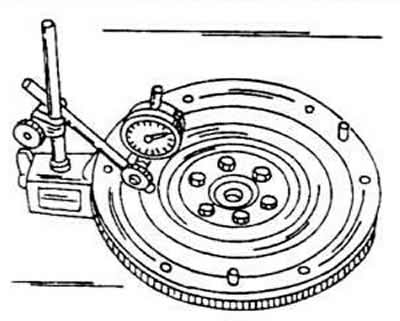
Before re-tightening the flywheel, it is necessary to check its runout. This is done using a measuring mechanism and a clock-type indicator. When the flywheel rotates slowly, the measuring mechanism pointer should not deviate more than 0.2 mm during movement. Otherwise, this flywheel should be replaced with a new one, since the curved friction surface has an adverse effect on the driven disk, and as a result, on the clutch.
When purchasing a new flywheel, be sure to specify the engine design, as different engines have different flywheels installed in their clutch systems.
The flywheel bolts are tightened evenly with a tightening torque of 70 Nm, and then they are tightened sequentially by the next 90°, but without a torque wrench.
(The text is copied from this portal: «www.VWMANUAL.ru»)
Visitor comments