



Check whether the springs of the receiving disk are still in good condition and whether the wedge teeth are excessively worn.
Since it is impossible to clean oily clutch linings, in such conditions it is necessary to replace the driven clutch disc with a new one.
Check the clutch linings for reuse by measuring the distance from the lining to the countersunk head of the rivet with a thickness gauge. If this measurement is less than 0.3 mm, the disc must be replaced with a new one. The disc is also replaced with a new one if this measurement is soon reached.
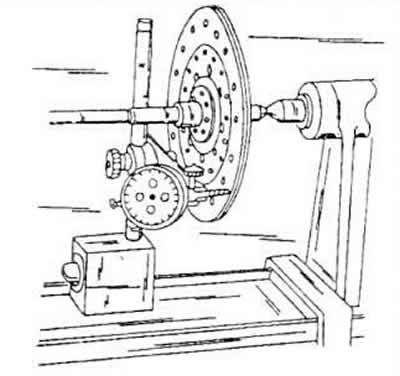
To check the driven disks for runout, they are clamped with a suitable mandrel or shaft between the conical clamps1 of a lathe. A measuring device with a clock-type interval is installed with a suitable support so that the index finger rests on the edge of this disk, namely: on the outer edge of the disk. The disk is slowly turned and the readings of the clock-type indicator are read. If the readings are more than 0.4 mm, then, if desired, careful alignment can be carried out with pliers. Otherwise, the disk can be replaced with a new one.
The alignment is checked by sliding the driven disk sleeve on the bevel gear engagements of the clutch shaft. To do this, the disk is mounted and grabbed on the outer edge between the projections and the index finger. The disk is slightly rotated in one direction and the other. If the gap is more than 0.4 mm, then the bevel gear engagement is worn. The cause of this can most likely be found in the driven disk.
Check the inner ends of the disc spring for wear. If deep grooves are visible, the clutch should be replaced completely. All tips of the disc spring should be at the same height within 0.5 mm. Bent tips can be bent again. A special tool is usually used for this, but you can also prepare a steel plate with a slot and bend the ends with it.
(The original can be seen on the portal: «vwmanual.ru»)
Check the clutch pressure plate for wear in the places indicated by the arrows.
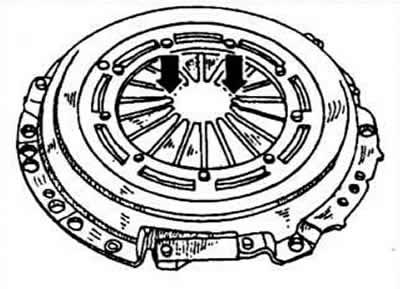
Check the inner ends of the disc spring for wear. If wear is visible at the points shown in the figure, the clutch should be replaced completely.
Checking the flat surface of the clutch pressure plate for warpage. The thickness gauge is inserted at the indicated locations.
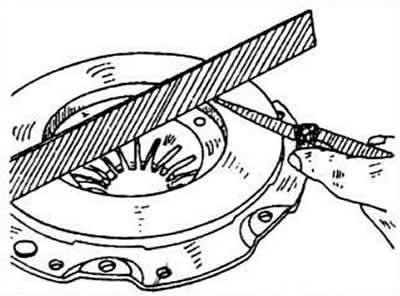
The measuring ruler is placed on the friction surface of the pressure plate, and the gap is measured with a thickness gauge. If the internal gap is more than 0.3 mm, the clutch should be replaced completely.
Visitor comments