



Replacing the clutch release bearing
The clutch system has a clutch release bearing with a ball bearing. The picture shows a gearbox with a clutch release mechanism on the inside of the gearbox. If this bearing is to be used again, it is not cleaned with lubricant-dissolving substances.
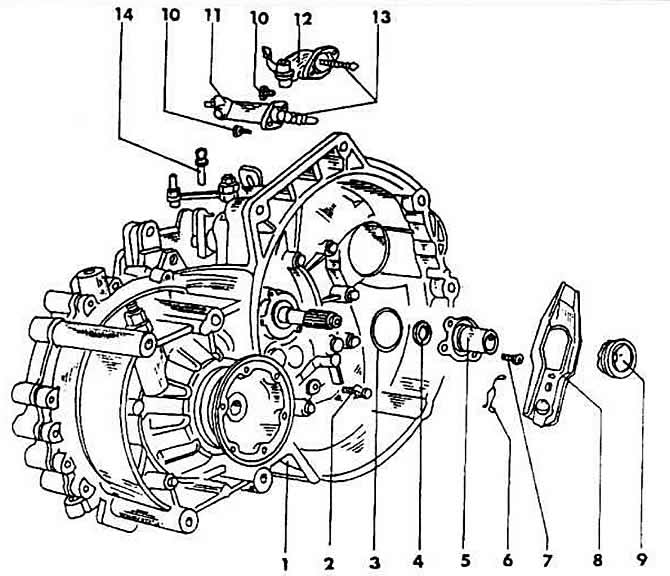
1 - gearbox
2 - ball head pin
3 - O-ring seal
4 - oil-proof ring, clutch shaft
5 - guide coupling
6 - safety brackets
7 - bolt, tightening torque 25 Nm
8 - clutch release mechanism lever
9 - clutch release bearing
10 - bolt, tightening torque 25 Nm
11 - receiving cylinder
12 - mechanical clutch drive
13 - pusher
14 - mounting pins
When replacing a bearing with a new one, proceed as follows.
They are removing the gearbox
the clutch release bearing brackets (9) are "unsprung" from this bearing and the bearing is pulled out.
If the clutch release lever (8) is to be removed, it must be pressed away from the ball-head pin (2) using a screwdriver.
Lubricate all bearing surfaces and surfaces in contact with it with graphite grease.
The clutch release bearing is inserted into the 8 clutch release lever and clamped with new brackets.
Installing the gearbox.
After installing the gearbox, check the clutch. In this case, first of all, attention is paid to the "scratching" noise when engaging each individual gear. Noises are heard, first of all, when engaging the reverse gear, if the clutch mechanism does not work.
Hydraulic system
The clutch is hydraulically actuated by a master and receiver cylinder. The master cylinder is located on the pedal support (secured with two bolts) and is held on the clutch pedal by one cotter pin.
The receiver cylinder is located on the top side of the gearbox and is held in place by bolts.
When removing and installing cylinders, the following instructions must be followed.
Before removing the master cylinder, remove the large windshield washer reservoir.
Before removing the receiver cylinder, remove the crank arm on the transmission wall. Do not disconnect the shift cable.
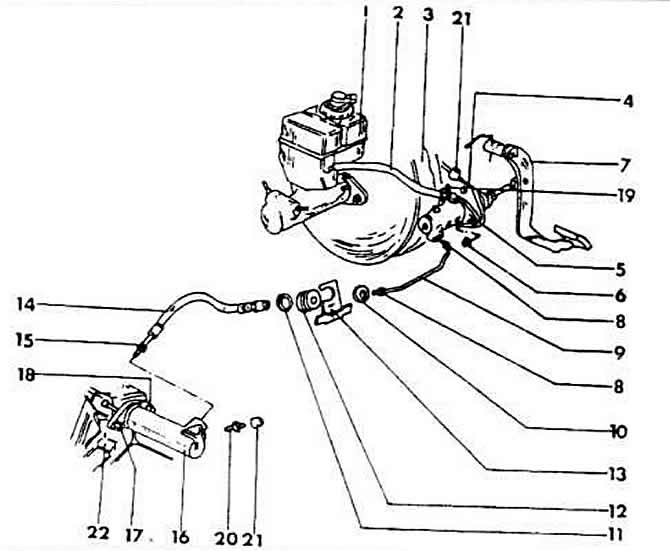
1 - liquid tank
2 - liquid hose
3 - brake booster
4 - fastening
5 - master cylinder
6 - nut, tightening torque 7 Nm
7 - clutch pedal
8 - union nut, tightening torque 15 Nm
9 - pressure hydraulic line tube
10, 11 - washers
12 - connector
13 - spring plate
14 - pressure hydraulic line hose
15 - union nut, tightening torque 15 Nm
16 - receiving cylinder
17, 18 - washers, tightening torque 25 Nm
19, 20 - threaded plugs of the ventilation hole
21 - dust protection cover
22 - gearbox
Blowing the hydraulic system
Bleeding the hydraulic system is done in the same way as bleed-out of the brake system, with the difference that the hose is attached to the air valve of the main brake system cylinder and the receiving clutch cylinder.
The system should always be bled if hydraulic lines have been disconnected or if air has entered the system in any other way. By moving the clutch pedal downwards, you can quickly determine whether there is pressure in the system. The pedal should move downwards with a constant pressure. Otherwise, the system must be bled.
Visitor comments