



Mark the position of the casing in relation to the flywheel (for example, by marking both parts with a center punch).
Loosen the six bolts securing the flywheel gradually and crosswise, releasing it from the spring pressure.
Remove the flywheel and driven disk.
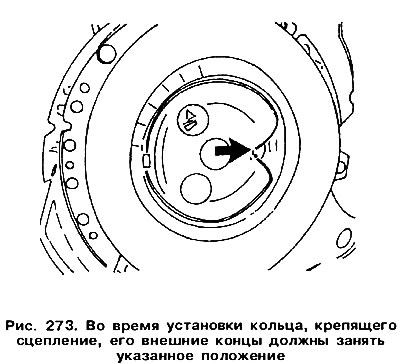
Using a screwdriver, remove the retaining ring 8 (see figure 209) from the groove of the connecting disk 7.
Remember how the ring was installed so that it will be in the same position during assembly.
Remove the driven disk.
Remove the bolts securing the clutch pressure plate to the crankshaft flange and remove the clutch.
Wipe the inside surface of the flywheel and pressure plate.
Every time the engine or gearbox is removed, the clutch should also be removed to check its technical condition.
The method for testing individual clutch components was given for the clutch of gasoline engines.
The clutch is installed in the reverse order.
In doing so, please follow the instructions below.
(The original can be found at: VWManual)
Clutch pressure plate 5 (see figure 209) place it on the crankshaft journal and place the central ring under the bolts. Cover the bolts with a locking compound for threaded connections "D6" and screw them in. Tighten gradually "crosswise" with a torque of 75 Nm.
If the engine plate 4 has been removed, it should be placed on the pin during assembly. Replace the gasket 1.
Lubricate the hole under the lever.
Install disk 7 and retaining ring 8 in the grooves so that both ends occupy the position shown in Figure 273.
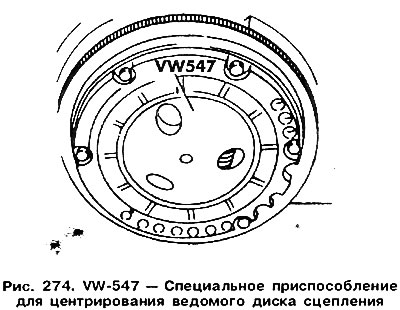
Insert slave disk (hub facing out), maintaining its central position. For this purpose, a special device VW-547 is used (figure 274).
Install the flywheel and secure it with bolts, tightening them to a torque of 20 Nm.
Visitor comments