English Русский
Български
Беларускі
Український
Српски
Hrvatski
Română
Polski
Slovenský
Magyar
  |  Articles  |  Sitemap  |  Contacts  |    |
Car maintenance Ford Car maintenance Hyundai Car maintenance Chevrolet Car maintenance BMW Car maintenance Audi Car maintenance Opel Car maintenance AvtoVAZ
VWmanual.ru


Main   Passat   Golf   Polo   Touareg   Tiguan   Sharan   Transporter   Others  
Golf 1 (1974-1984, diesel) Golf 1 (1974-1984, petrol) Golf 2 (1984-1993, petrol) Golf 2 (1984-1993) Golf 3 (1991-1997) Golf 4 (1997-2004) Golf 5 (2003-2008)

Volkswagen Golf and Jetta Manual System: Preliminary Information (VW Golf 2)

  • Main
  • Golf
  • Golf 2
  • General information
  • Car care
  • Volkswagen Golf and Jetta Manual System: Preliminary Information
            0


Contents: Lifting and towing ↓ Towing ↓
The M-2 Volkswagen Golf and Jetta models have been produced since March 1984. The main difference from earlier models is the modified body and additional equipment elements.

The engine and gearbox are located at the front transversely to the car, the drive is transmitted to the front wheels. The mechanics have been modernized to increase useful power and reduce fuel consumption.

Like earlier models, the M-2 is popular for its economy, reliability and ride comfort.

Lifting and towing


The jack supplied with the tool kit by the manufacturer, unless provided with a stand, should only be used in the event of a wheel change on the road.

This is a "half-scissor" type jack. Before using the jack, check and tighten the handbrake. The car should only be lifted on a firm, level surface. If the ground is not firm, place a large board under the jack stand to provide additional support.

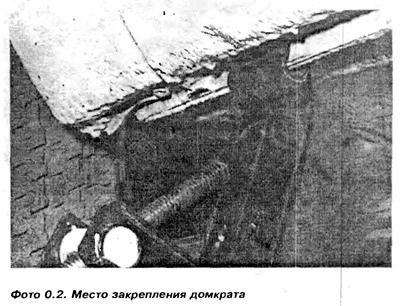
Place supports under the wheel on the opposite side of the vehicle from the one being lifted. Using the tool supplied by VW, remove the wheel cap where necessary, then loosen the wheel bolts by half a turn. Place the jack arm under the sill reinforcement as close as possible to the wheel being changed (photo 0.1 and photo 0.2). Rotate the jack handle until its base touches the ground directly under the threshold. Check the jack installation again and continue to rotate the handle until the wheel touches the base. Loosen the wheel bolt and remove the wheel. Place the spare wheel on the wheel hub journal, put on and tighten the bolts crosswise.


Lower the jack and tighten the bolts to the end. Secure the wheel cap. Remove the supports from under the wheel, put the tool kit, jack and wheel in the trunk.
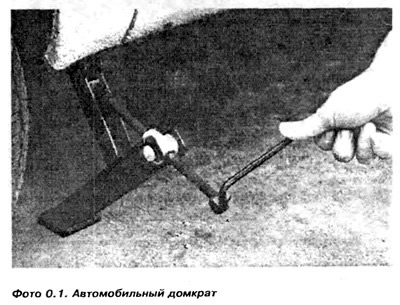
View the original on this resource: vwmanual.ru

Lower the jack and tighten the bolts to the end. Secure the wheel cap. Remove the supports from…


Lower the jack and tighten the bolts to the end. Secure the wheel cap. Remove the supports from…


Lower the jack and tighten the bolts to the end. Secure the wheel cap. Remove the supports from…


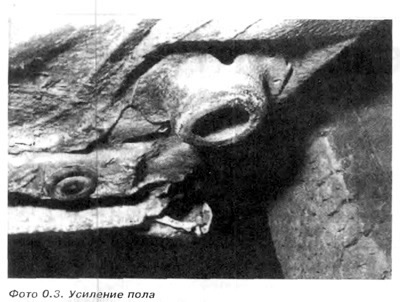
When lifting a vehicle using a pole jack or a frog jack, place the jack under the floor reinforcement used for this purpose (photo 0.3). Caution: Never lift a vehicle by placing the jack under suspension components or axle shafts, the oil pan or the gearbox. These components can be supported, for example, when replacing engine mount brackets, but never use them to lift the entire vehicle.


Towing


Towing hooks are mounted at the front and rear of the vehicle (photo 0.4 and photo 0.5).
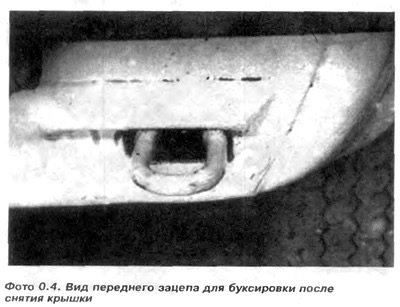
Towing hooks are mounted at the front and rear of the vehicle (photo 0.4 and photo 0.5).
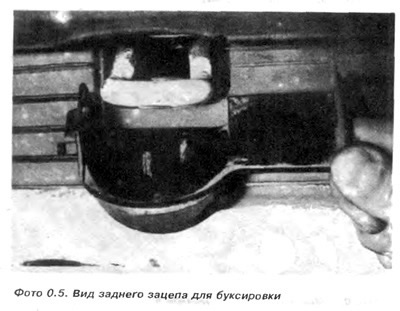

Towing hooks are mounted at the front and rear of the vehicle (photo 0.4 and photo 0.5).


The front hitch is covered with a plastic cap; to open the hitch for towing, you need to squeeze the cap and simultaneously pull it forward.

The towing rope should not be tied to any other element. It is better to use a rope to reduce the tension in both cars. This can be a rope made of artificial fiber or a rope with an elastic connector.

When towing, the following precautions must be observed:

a) Turn the ignition key in the towed vehicle to unlock the steering wheel.

b) Remember that when the engine is not running, the brake booster does not work. Therefore, you need to press the brake pedal harder to get the same braking effect.

c) On models equipped with power steering, additional force will be required to turn the steering wheel when the engine is not running.

d) In cars with an automatic transmission, the gearshift lever must be set to the "N" position. Since the front wheels are not raised above the ground, you should not tow the car faster than 45 km / h and for more than 45 km. For longer distances, you must transport the car on two wheels with the front wheels raised. When the engine is not running, the transmission oil pump does not work, and the transmission is not lubricated enough. Towing a car with an automatic transmission when the rear wheels are raised and the front wheels are rolling is unacceptable. In reverse gear, the maximum speed that can be reached is 30 km / h. If the car is towed at a speed of 60 km / h, the transmission system will be forced to rotate at a very high speed for which it is not adapted, which will cause damage to the transmission mechanism

d) Before starting towing, turn the ignition key to the on position so that the turn signals, brake lights, windshield wipers and horn can be turned on.

Purchase of spare parts


Spare parts are available from VW workshops, other workshops and auto parts stores, as well as from wholesale auto parts warehouses.

To be sure that you have bought the part that is needed, you need to indicate the engine and chassis number of the car or, if possible, bring the old part for identification.

It is best to buy spare parts from an authorized company that sells original spare parts. It is much more reliable to buy a genuine spare part, as it will pay for itself in more than one cut due to its durability. Oil filters, spark plugs, light bulbs, toothed belts, V-belts, oils and lubricants, tires, paints, spatulas, etc. Volkswagen are world famous.

Vehicle Identification Numbers


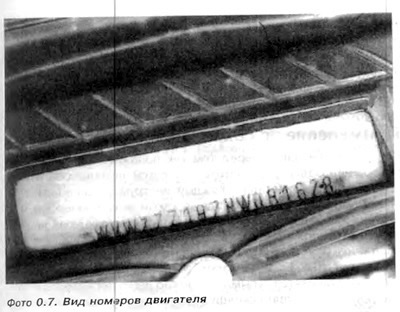
Vehicle identification numbers are very important when ordering parts or obtaining information about the vehicle. The vehicle identification plate is located in the engine chamber on the right side.
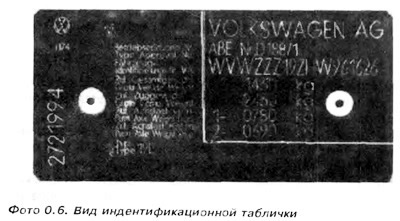
Vehicle identification numbers are very important when ordering parts or obtaining information…


Vehicle identification numbers are very important when ordering parts or obtaining information…


Vehicle identification numbers are very important when ordering parts or obtaining information…


The chassis number is located in the engine compartment on the bulkhead separating the engine from the passenger compartment (under the windshield).

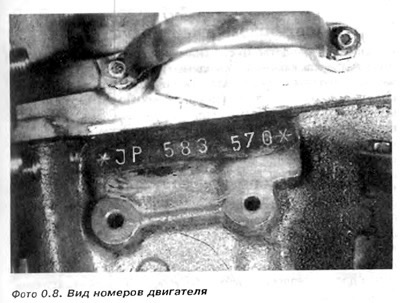
The engine number in 1.05 and 1.3 L models is located on the cylinder block near the generator bracket.

The engine number on 1.6 and 1.8 L models is located on the left side of the cylinder block.

These numbers must be identified and recorded by the owner of the car so that they can be used if necessary (for example, in case of car theft).

This article is available at russian, bulgarian, belarusian, ukrainian, serbian, croatian, romanian, polish, slovak, hungarian
The text has been checked: Semenova Anna

Share information:

Previous articles
Next articles
Car operation: the first 1500 km of mileage and subsequent
Safety rules for operating a car
Driving: economically and with minimal air pollution
Instructions for driving a car with a trailer
Car Care: Fuel Tank
Car care: fuel supply


Similar articles from other manuals for VW cars:
General information about the lubrication system Passat B3 (1988-1993)
Power supply system. General information Polo 4 (2001-2009)
Warning and information messages on the display Touareg 1 (2002-2006)
General information about the brake system Tiguan 1 (2007-2015)
Diesel Engine Cooling System — General Information Sharan 1 (1995-2000)
Engine fuel system — general information Transporter T4 (1990-2003)
General information on removing and installing fuel system… Caddy 3 (2003-2010)
Link to this page in different formats


Visitor comments


No comments yet


How much will 15 + 32 =


Golf 5 
  • General information
  • User manual
  • Maintenance
  • Troubleshooting
  • Power unit
  • Engine repair
  • Cooling and ventilation system
  • Fuel system
  • Ignition system
  • Transmission
  • Clutch
  • Mechanical gearbox
  • Automatic gearbox
  • Chassis
  • Brake system
  • Car suspension
  • Steering
  • Body
  • Interior (internal elements)
  • Exterior (external elements)
  • Doors and covers
  • Electrical equipment
  • Power devices
  • Washers and wipers
  • Lighting and appliances
  • Electrical circuits
Golf 4 
  • General information
  • User manual
  • Weekly checks
  • Maintenance
  • Power unit
  • Petrol engines
  • Diesel engines
  • Cooling system
  • Fuel system (petrol)
  • Control system (petrol)
  • Fuel system (diesel)
  • Exhaust system
  • Transmission
  • Clutch
  • Car gearbox
  • Drive shafts
  • Chassis
  • Car suspension
  • Steering
  • Wheels and tires
  • Brake system
  • Body
  • Exterior (external elements)
  • Interior (internal elements)
  • Ventilation and heating
  • Car doors and sunroof
  • Washers and glass cleaners
  • Electrical equipment
  • Power devices
  • Lighting and appliances
  • Electrical circuits
Golf 3 
  • Petrol engine
  • Engine repair
  • Lubrication system
  • Cooling system
  • Ignition system
  • Diesel engine
  • Engine repair
  • Diesel injection system
  • Pre-glow system
  • Transmission
  • Clutch
  • Gearbox and drive shafts
  • Chassis
  • Steering
  • Wheels and suspension
  • Brake system
  • Electrical equipment
  • Lighting and appliances
  • Electrical circuits
Golf 2 
  • General information
  • Introduction to guide
  • User manual
  • Petrol engines 1.3 l
  • Engine repair
  • Lubrication system
  • Cooling system
  • Carburetors
  • Supply system
  • Ignition system
  • Petrol engines 1.6/1.8 l
  • Engine repair
  • Supply system
  • Ignition system
  • Diesel engines
  • Engine repair
  • Lubrication system
  • Cooling system
  • Power and exhaust system
  • Transmission
  • Clutch
  • 4-speed gearbox 084
  • 5-speed gearbox 085
  • 4-speed gearbox 020/4R
  • 5-speed gearbox 020/4T
  • Automatic gearbox
  • Drive shafts
  • Chassis
  • Steering
  • Car suspension
  • Brake system
  • Body
  • Body elements
  • Doors, locks and windows
  • Electrical equipment
  • Equipment and devices
  • Power devices
Golf 2 (petrol) 
  • General information
  • Characteristics
  • Car care
  • Maintenance
  • Power unit
  • Engine repair
  • Engine 1.05/1.30
  • Engine 1.60/1.80
  • Cooling and lubrication system
  • Power and exhaust system
  • Transmission
  • Clutch
  • Car gearbox
  • Drive shafts
  • Chassis
  • Brake system
  • Steering
  • Suspension
  • Body
  • Body and equipment
  • Electrical equipment
  • Lighting and appliances
  • Electrical circuits
Golf 1 (petrol) 
  • General information
  • Characteristics
  • User manual
  • Maintenance
  • Power unit
  • Engine adjustment
  • Engine 1.1/1.3
  • Engine 1.5/1.6/1.8
  • Engine electrical equipment
  • Cooling system
  • Fuel system
  • Transmission
  • Clutch and manual gearbox
  • Automatic gearbox
  • Chassis
  • Steering
  • Front suspension
  • Rear suspension
  • Brake system
  • Electrical equipment
  • Lighting and appliances
  • Electrical circuits
  • Body
  • Body and equipment
  • Optional equipment
Golf 1 (diesel) 
  • General information
  • Specifications
  • Maintenance
  • Power unit
  • Engine repair
  • Exhaust and turbocharger
  • Cooling system
  • Fuel system
  • Fuel injection system
  • Transmission
  • Clutch and drive shafts
  • Car gearbox
  • Chassis
  • Suspension and wheels
  • Steering
  • Brake system
  • Wheels and tires
  • Body
  • Heating and ventilation
  • Exterior (external elements)
  • Interior (internal elements)
  • Doors and windows
  • Electrical equipment
  • Equipment and devices
  • Lighting system
  • Power devices
  • Electrical circuits
VWmanual.ru © 2016-2026 | Mobile version | News and articles | Sitemap: EN BG BY UA RS HR RO PL SK HU | Write message | Site search
Passat B2 • Passat B3 • Passat B4 • Passat B5 • Passat B6 • Golf 1, diesel • Golf 1, petrol • Golf 2, petrol • Golf 2 • Golf 3 • Golf 4 • Golf 5 • Polo 3 • Polo 4 • Touareg 1 • Tiguan 1 • Sharan 1 • Transporter T3 • Transporter T4 • LT 28 • LT 2D • Beetle • Caddy 3 •
Our website uses cookies to ensure functionality and convenience.