



Contents: Removal the radio (old design) ↓ Removal the radio (new design) ↓ Self-installation of a radio receiver ↓
The cars described already have a radio receiver with a separate front panel installed at the manufacturer. The newest radio receivers are integrated into the panel. Therefore, removal and installation may vary.
Removal the radio (old design)
Remove the buttons. Remove the switch or spacer.
Use a small screwdriver or needle to push the small clips of the radio flap to the sides (under the buttons). Remove the damper.
On one side of the radio, use a screwdriver to move the retaining clip slightly inward (illustration); pull the radio out a little.
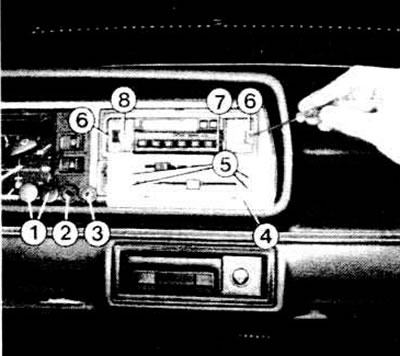
Removal the radio: 1 - buttons: 2 - switch; 3 - spacer ring; 4 - damper; 5 - metal clamps; 6 - fixing clamps; 7 - antenna tuning screw; 8 - handles.
On the opposite side, move the locking bracket inward; remove the radio receiver. Make sure that the second bracket does not engage again.
Remove all radio cables without exception.
When installing the radio panel plug, pay attention to the "Oben" ("Up") indication stamped on the back of the plug.
Removal the radio (new design)
To carry out professional dismantling, the workshop has two U-shaped wire squares. Auxiliary tools can also be 4 suitable nails or auxiliary tools from another company that produces radio receivers.
Insert both squares or four nails into the side holes of the radio, which will cause the radio's retaining clips to be pressed inward.
Remove the radio receiver; remove the cable plug and the antenna plug.
(View the original on this portal: «www.VWmanual.ru»)
Self-installation of a radio receiver
Buy suitable parts for mounting the radio receiver so that there are no problems with fastening.
Remove the storage box located in the instrument panel by grasping it in the middle, at the top and at the bottom.
If necessary, secure the mounting hardware for the radio receiver.
Cover the body of the radio receiver with strips of foam plastic; this will help prevent possible noise.
Remove the ground from the battery.
In most cases, upgraded equipment includes wires for connecting a radio receiver.
If there are no wires, connect to one of the "H" connections in the central part of the electrical equipment (in the production model until July 1982.) or "R" (released after August 1982.) to the DC line (terminal 30); in between, turn on the radio fuse.
Run a ground wire to the radio receiver.
Since September 1981, the radio wires have been assembled into a single four-pin connector.
The colors of the cables mean the following:; red - plus, brown - minus: grey-blue - illumination of the radio receiver scale, black for the antenna.
Connect the radio receiver.
Install the antenna as described in the section "Installing the antenna".
Install a jamming system.
Temporarily connect a loudspeaker to the radio.
Connect the ground to the battery. Turn on the radio to check its operation.
If necessary, adapt the radio receiver to the antenna using the tuning screw.
To do this, find a weak radio transmitter between 1200 and 1500 kHz on medium waves.
Turn the tuning screw until the station can be heard loudly and clearly enough.
Visitor comments