



Contents: The lower part of the car ↓ Checking the protective layer of the…↓ Cleaning the water drainage holes ↓ Preservation of cavities ↓ Rusty places ↓ Panels for car repair ↓
The lower part of the car
Car maintenance plays a significant role in combating corrosion, especially in winter when salt is spread on the roads. Salt and street dirt should not linger in the corners and edges of the lower part of the car for a long time, as they attract moisture. The already poorly accessible corners do not dry out at all, which contributes to the appearance of corrosion. Pay special attention to the following places:
- front fenders above headlights;
- flanging of all four wheel arches;
- wheel arches;
- rear wheel arch area;
- fuel lines in the rear right wheel arch.
Checking the protective layer of the bottom
The protective layer of the bottom of the machine should be carefully checked. If necessary, additional treatment is required.
Thoroughly wash the underside of the car.
Illuminate the entire lower part of the car with a lamp and identify damaged areas
Clean damaged areas in the protective layer of the base until shiny using a spatula, wire brush and scraper.
Cover the cleaned surfaces with a layer of anti-corrosion agent (eg. "Rostprimer" or "Bleimennigc").
Flat large surfaces are treated with a special soft substance.
For hard-to-reach corners and joints, it is more convenient to use a protective agent in an aerosol can.
Cleaning the water drainage holes
None of the welds are so tight that water cannot penetrate. Therefore, all hollow sections in the car have drainage holes for water. If these holes are clogged with dirt or anti-corrosion agent, the water that has penetrated cannot flow out. The accumulation of water accelerates the formation of rust from the inside. This is especially dangerous for the longitudinal elements of the body.
Clean the holes periodically.
If the vehicle is equipped with a sunroof, the roof drainage holes should be additionally checked.
The drainage holes are located at the front at the height of the upper door hinges: at the rear they are led out behind the wheel arch on the right and left.
For cleaning (front top, back bottom) the cable from the old speedometer shaft fits.
Preservation of cavities
Preservation of cavities carried out in production conditions lasts only for a limited time. In addition, not all metal surfaces are coated with a protective agent during processing. Complete coverage was achieved only in new models of cars, where the hot filling method was used. In the workshop, you can determine whether it is profitable or not to additionally process your car. If there is no rust in the cavities yet, additional processing is worth doing. But this work should be carried out by a workshop with special equipment. For example, special probes and high working pressure are used. Aerosol cans are only profitable if you want to process a well-accessible cavity, for example, a door.
Note: If the metal is heavily rusted, even the best preservative won't help. Only welding will help.
Rusty places
Older Volkswagen models have characteristic places where rust eats through the metal. Removable fenders, doors and trunk lids do not pose a problem. The difficulties are associated with the so-called load-bearing parts, which require welding, which makes repairs significantly more expensive. If you have bought a used car, you should check the following places, shown in the picture below.
Support surfaces of the wings, right and left in the engine compartment.
Rear wheel arches.
The pillar at the bottom between the window opening and the surface near the windshield.
Thresholds outside and inside (covered with rugs).
The longitudinal beam of the frame at the bottom of the car in the places where the rear axle is attached.
Note: If the rear axle mounting points are rusted, in most cases the entire body is already so rusted that repair is useless.
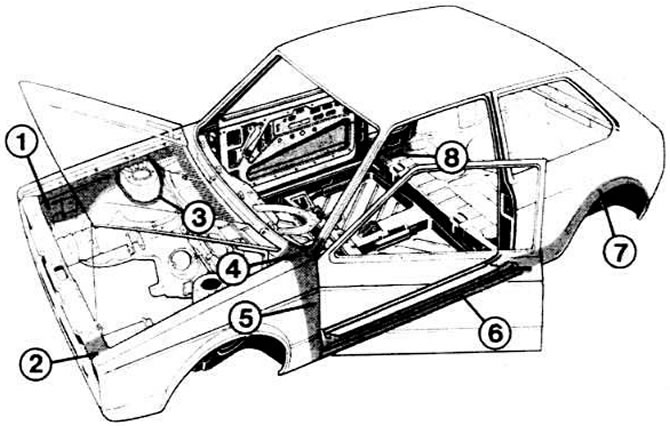
Parts of the body susceptible to corrosion: 1 - supporting surfaces of the wings; 2 - the part between the support and the front panel; 3 - weld seam; 4 - surface near the rack; 5 - door hinges; 6 - threshold; 7 - rear wheel tire; 8 - rear axle mount.
Panels for car repair
If the car, which is still in good condition, has rusted body panels, this is not a reason to send the car to the dump. There are special repair panels, they have the right shape and size.
The panels are welded to replace the damaged parts. A professionally performed repair with replacement of the rusted sheet and welding of new parts is so expensive that it is not profitable to carry it out if the car is old.
Visitor comments