



Contents: Checking the voltage regulator on a…↓ Checking the condition of carbon…↓ Driving with a faulty alternator ↓
It is difficult and impractical to repair a generator on your own, since a special stand will be required to determine its serviceability and whether its characteristics correspond to the nominal ones.
Therefore, it is better to entrust the generator repair to qualified specialists at the company's service station "Volkswagen", where you can also replace the generator from the exchange fund. Such a generator will be 50% cheaper than a new one. However, before changing the generator, you can carry out the following checks.
Checking the voltage regulator on a car
To check the voltage regulator, you need to have a DC voltmeter with a scale of up to 15-30 V, accuracy class no worse than 1.0.
Check the voltage regulator installed on the vehicle in the following order:
- start the engine and let it run for about 15 minutes at medium speed;
- using a voltmeter measure the voltage between terminal "30" (terminal of thick red cable on generator) and the "mass" of the generator;
- the voltage should be between 13.3-14.6 V.
If systematic undercharging or overcharging of the battery is observed and the regulated voltage does not fit within the specified limits, the voltage regulator must be replaced. In addition, the condition of the carbon brushes can be checked.
Checking the condition of carbon brushes
Although this work can be done with the generator installed, it is still recommended to remove the generator from the vehicle.
Check the condition of the carbon brushes in the following order:
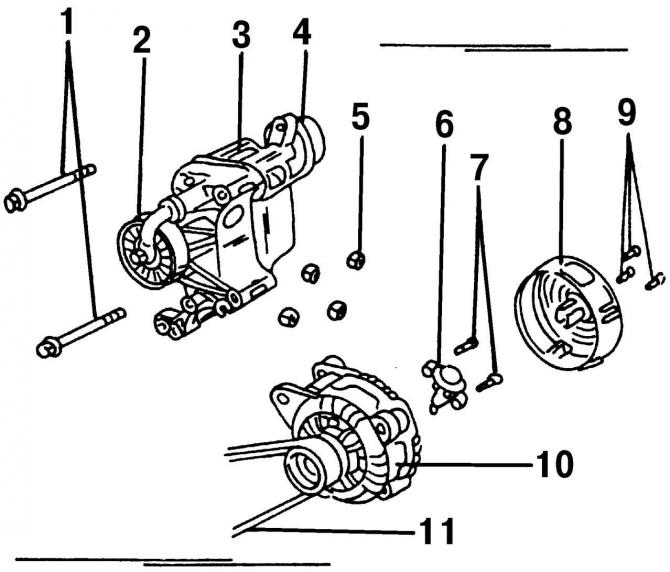
Fig. 334. Generator parts and its fastening on a 2.0-liter engine: 1 - bolts M8, 25 Nm; 2 - tension roller; 3 - bracket; 4 - tensioner; 5 - nut M8, 30 Nm; 6 - voltage regulator; 7 - voltage regulator mounting bolts, M4; 8 - casing; 9 - casing mounting bolts; 10 - generator; 11 - poly V-belt
- unscrew bolts 9 (Fig. 334) securing the casing and remove the casing;
- unscrew the two bolts 7 securing the voltage regulator 6;
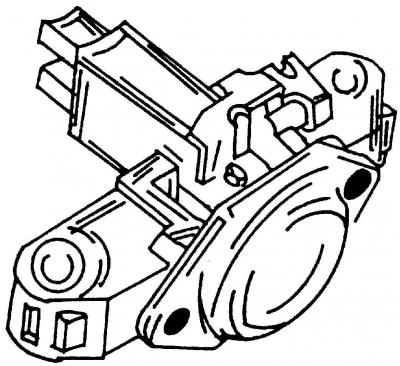
Fig. 336. Voltage regulator assembly with brush holder and carbon brushes. Measure how far the ends of the carbon brushes protrude
- carefully remove the voltage regulator assembly with the brush holder and generator brushes from the generator housing (Fig. 336);
- measure the length of the carbon brushes protruding from the brush holder. If their length is less than 5 mm, the brushes should be replaced.
The new carbon brush is 13 mm long, so you can find out how worn the carbon brushes are. Replacing old carbon brushes with new ones means replacing the entire voltage regulator assembly with brushes and a brush holder, since the carbon brushes are soldered into the brush holder. However, if you wish, you can contact a Bosch service station to replace only the carbon brushes. Since the car has Bosch parts, this operation should not cause any problems.
Driving with a faulty alternator
If during the trip it is discovered that the generator no longer charges the battery (the battery discharge indicator light on the instrument panel is constantly on), then this means that the generator does not produce voltage, or the discharge control lamp circuit is faulty, or the electronic voltmeter is faulty. In daylight hours, you can drive for several more hours (provided that the battery is in good condition).
The original text can be found on the portal www.VWManual.ru
In this situation, follow these recommendations:
- if possible, do not turn off the engine, as restarting it consumes a lot of energy;
- if you still need to turn off the engine, then park the car on a slope so that you can start the engine by pushing the car down the slope;
- turn off the rear window heating, radio and heater;
- if it is raining lightly, set the windshield wipers to intermittent mode;
- if you have to drive in the dark, turn on only the low beam.
Visitor comments