
English Русский
Български
Беларускі
Український
Српски
Hrvatski
Română
Polski
Slovenský
Magyar
  |  Articles  |  Sitemap  |  Contacts  |    |
Car maintenance Ford Car maintenance Hyundai Car maintenance Chevrolet Car maintenance BMW Car maintenance Audi Car maintenance Opel Car maintenance AvtoVAZ
VWmanual.ru


Main   Passat   Golf   Polo   Touareg   Tiguan   Sharan   Transporter   Others  
Transporter T3 (1979-1992) Transporter T4 (1990-2003)

Generator — design description (VW Transporter T4)

  • Main
  • Transporter
  • Transporter T4
  • Electrical equipment
  • Power devices
  • Generator — design description
            0


Generator (4-cylinder diesel engine since 10/92, 5-cylinder petrol engine since 10/91)
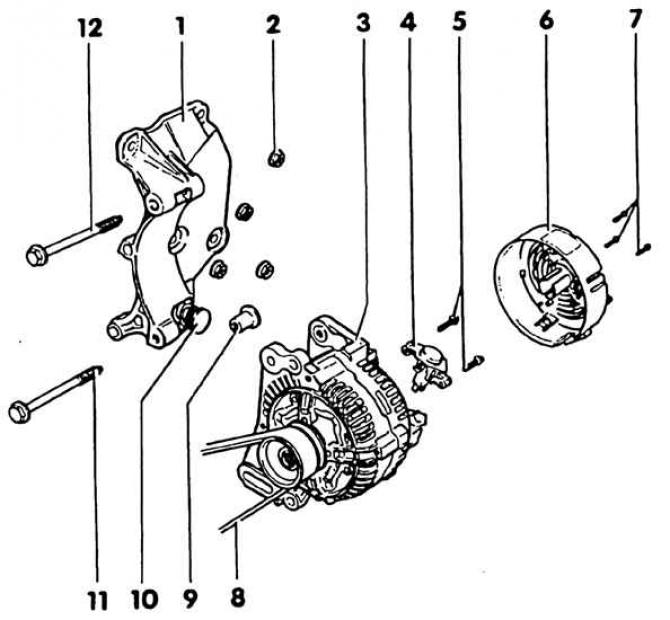


1. Bracket; 2. Hexagon nuts M8, 30 Nm; 3. 3-phase AC generator; 4. Voltage regulator; 5. Screws; 6.…

1. Bracket; 2. Hexagon nuts M8, 30 Nm; 3. 3-phase AC generator; 4. Voltage regulator; 5. Screws; 6. Protective cap; 7. Hexagonal screws MZ; 8. V-belt; 9. Sleeve with internal thread M8; 10. Tension spring with guide cap; 11. Hexagonal screw M8, 25 Nm; 12. Hexagonal screw M8, 25 Nm


VW T4 is equipped with a 3-phase alternator. Depending on the model and equipment, alternators can be installed with different power. The power is indicated on the current plate on the alternator.

Attention! If additional electrical equipment is installed, it is necessary to check whether the installed generator has sufficient power. If necessary, install a more powerful generator.


The generator is driven from the crankshaft by a V-belt. The rotor with the excitation winding rotates inside the stationary stator winding at a speed twice the engine speed.

An excitation current flows through the graphite brushes, collector, and excitation winding, forming a magnetic field.

The position of the magnetic field relative to the stator winding constantly changes, in accordance with the rotation of the rotor. In this case, an alternating current is created in the stator winding.


Since the battery can only be charged with direct current, the alternating current is converted into direct current through a diode rectifier. The voltage regulator changes the charging current by switching the excitation current on and off, according to the charging state of the battery. At the same time, the regulator maintains a constant operating voltage of about 14 V, regardless of engine speed.

Precautions when handling the generator


When working on the electrical system in the engine compartment, always disconnect the ground (-) cable from the battery.

Do not confuse the voltage regulator cable with the generator. Before disconnecting, mark the cables with adhesive tape.

Do not disconnect the battery or voltage regulator while the engine is running.

Do not remove the generator while the battery is connected.

When carrying out electric welding work on machines, always disconnect the battery.

This article is available at russian, bulgarian, belarusian, ukrainian, serbian, croatian, romanian, polish, slovak, hungarian
The text has been checked: Orlov Dmitry

Share information:

Previous articles
Diagnosis of battery faults
Self-charging of the battery
Storage of the battery
Charging the battery
Checking the battery
Removal and installation the battery
Next articles
Checking the generator voltage
Removal and installation the generator
Replacing the generator's graphite brushes and checking the voltage regulator
Generator fault diagnostics
Starter — General Information
Removal and installation the starter


Similar articles from other manuals for VW cars:
Front axle design Passat B3 (1988-1993)
Removal and installation the generator Golf 1 (1974-1984, petrol)
Car Generator Polo 3 (1995-2003)
Design features of an off-road vehicle Touareg 1 (2002-2006)
Generator (1.4L TSI engine) Tiguan 1 (2007-2015)
VR6 Engine — Design Description Sharan 1 (1995-2000)
Generator — design description Beetle (1960-1986)
Link to this page in different formats


Visitor comments


No comments yet


How much will 37 + 42 =


Transporter T4 
  • General information
  • User manual
  • Maintenance
  • Power unit
  • Engine repair
  • Ignition system
  • Lubrication system
  • Cooling system
  • Fuel system (petrol)
  • Fuel system (diesel)
  • Injection system (petrol)
  • Exhaust system
  • Transmission
  • Clutch
  • Car gearbox
  • Chassis
  • Car suspension
  • Steering
  • Brake system
  • Wheels and tires
  • Body
  • Exterior
  • Interior
  • Doors and windows
  • Heating system
  • Electrical equipment
  • Equipment and devices
  • Lighting and signaling
  • Power devices
  • Electrical circuits
Transporter T3 
  • General information
  • Maintenance
  • Petrol engines
  • Engine repair
  • Lubrication system
  • Cooling system
  • Power and exhaust system
  • Carburetor 34 PICT
  • Carburetors 2E3 and 2E4
  • Fuel injection system
  • Ignition system
  • Diesel engines
  • Engine repair
  • Lubrication system
  • Cooling system
  • Power and exhaust system
  • Transmission
  • Clutch
  • Car gearbox
  • Chassis
  • Front suspension
  • Rear suspension
  • Steering
  • Brake system
  • Body
  • Body and interior elements
  • Doors, locks and windows
  • Electrical equipment
  • Lighting system
  • Equipment and devices
  • Power devices (diesel)
  • Power devices (petrol)
  • Wiring diagrams (diesel)
  • Wiring diagrams (petrol)
VWmanual.ru © 2016-2026 | Mobile version | News and articles | Sitemap: EN BG BY UA RS HR RO PL SK HU | Write message | Site search
Passat B2 • Passat B3 • Passat B4 • Passat B5 • Passat B6 • Golf 1, diesel • Golf 1, petrol • Golf 2, petrol • Golf 2 • Golf 3 • Golf 4 • Golf 5 • Polo 3 • Polo 4 • Touareg 1 • Tiguan 1 • Sharan 1 • Transporter T3 • Transporter T4 • LT 28 • LT 2D • Beetle • Caddy 3 •
Our website uses cookies to ensure functionality and convenience.