



1. Use a charged battery for testing.
2. Turn off the ignition.
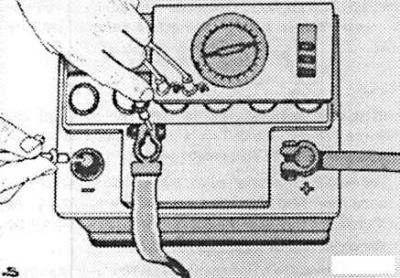
3. Set the ammeter (measuring range from 0–5 mA to 5 A) to the largest measuring range. Disconnect the ground cable from the battery. Connect the ammeter to the negative terminal of the battery and the ground cable.
Attention! The test can also be performed using a test lamp. If the lamp connected to the negative pole of the battery and the negative cable still does not light, then it is necessary to connect an ammeter.
4. Turn off all electrical consumers: existing clock (regular consumer) disconnect, close doors.
5. Switch the ammeter to the milliammeter range until a current value appears (1–3 mA is acceptable).
6. By removing fuses in sequence, break the circuits. If the reading drops to zero with any open circuit, then look for the source of the malfunction here. Malfunctions can be: corroded and dirty contacts, frayed wires, internal short circuits in units.
7. If no fault is found in the protected circuits, then it is necessary to disconnect the wiring from the unprotected circuits. These are: generator, starter, ignition system.
8. If the needle drops to 0 when disconnecting an unprotected unit, check the unit or replace it. If there is a current leak in the starter or ignition system, check the ignition switch using the electrical diagram (see subsection 10.20.7).
9. Connect the ground (-) cable to the battery.
Caution! Connect the battery only when the ignition is switched off, otherwise the injection system control unit may be damaged.
10. Set the time on the clock.
11. Enter the anti-theft radio code.
Visitor comments