



Contents: Checking tire inflation pressure ↓ Tire inflation pressure chart since…↓ Checking the chamber valve ↓ Checking the tire tread pattern ↓
Checking tire inflation pressure
Check tire inflation pressure only when tires are cold.
Check the tyre inflation pressure once a month and also as part of maintenance.
Additionally, the tyre inflation pressure should be checked before long journeys on the motorway, as this is when the temperature load on the tyres is highest. At a long, high speed, a tyre with low inflation pressure is subject to greater lateral deformation when rolling and also becomes very hot. This can result in profile separation or the tyre bursting. In addition, low inflation pressure increases fuel consumption.
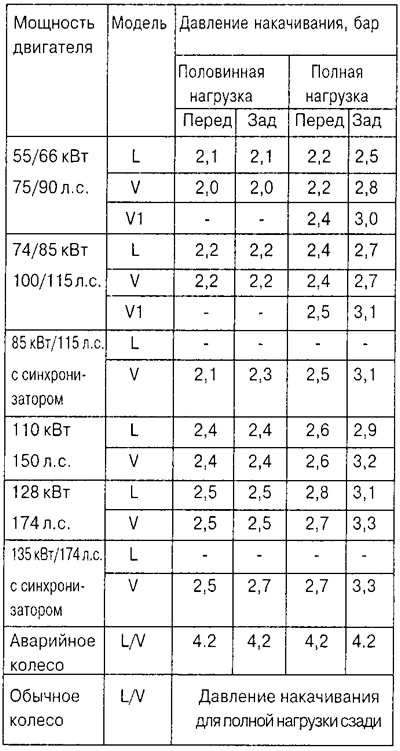
Tire inflation pressures are indicated on the sticker on the inside of the fuel tank cap.
For driving on motorways, it is recommended to increase the tyre inflation pressure by 0.2 bar.
Tire inflation pressure chart since 9/93
Petrol engines
Diesel engines
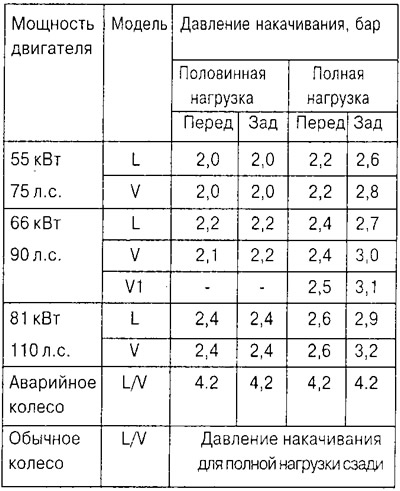
L — Limousine, V — Variant, V1 — Limousine with increased payload.
Checking the chamber valve
Unscrew the dust cap from the valve.
Wet the valve with soapy water or saliva. If an air bubble forms, tighten the valve tightly using the inverted dust cap.
Note: The valve can only be tightened with a metal cap. This cap is located on the fuel tank side.
Check the valve again. If air bubbles form again and the valve does not tighten further, it must be replaced.
Be sure to reattach the dust cap.
Checking the tire tread pattern
Tires of balanced wheels, with conscientious observance of the prescribed tire pressure, with correct installation of the wheels and operation of the shock absorber, wear out over the entire working surface approximately evenly. Otherwise, it is generally impossible to draw a conclusion about the service life of tires of a certain manufacturer, since this service life depends on various factors:
- quality of road surface
- tire inflation pressure
- driving style
- weather conditions
First of all, rapid wear of tires is caused by a sporty driving style, quick starting off and sharp braking.
Note: In fairness, it should be said that the tread pattern height can decrease to 1.6 mm when worn, namely, the depth of the tread pattern grooves over the entire working surface should still be at least 1.6 mm. However, for safety reasons, it is recommended to replace tires when the tread pattern height is at least 3 mm.
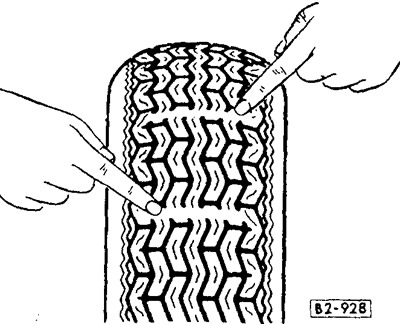
If the tread depth is approaching the minimum permissible value, and the prescribed wear value of 1.6 mm is exceeded in many places around the perimeter of the tyres and the pattern is no longer present, this means that such tyres must be replaced.
Please note: Tyres with a winter tread pattern marked M+S have sufficient impact on mud and snow only if the tread depth is at least 4 mm.
Attention: Check the tires for cuts. If cuts are found, determine their depth with a small screwdriver. If the depth of the cut reaches the carcass, then the steel cord of the tire correlates due to water penetration. Under such circumstances, the working surface lags behind the carcass, the tire begins to crack. Therefore, if the tread is deeply cut, replace the tire for safety reasons.
Visitor comments