



Elements of the lubrication system of the four-cylinder engine 1.8-I
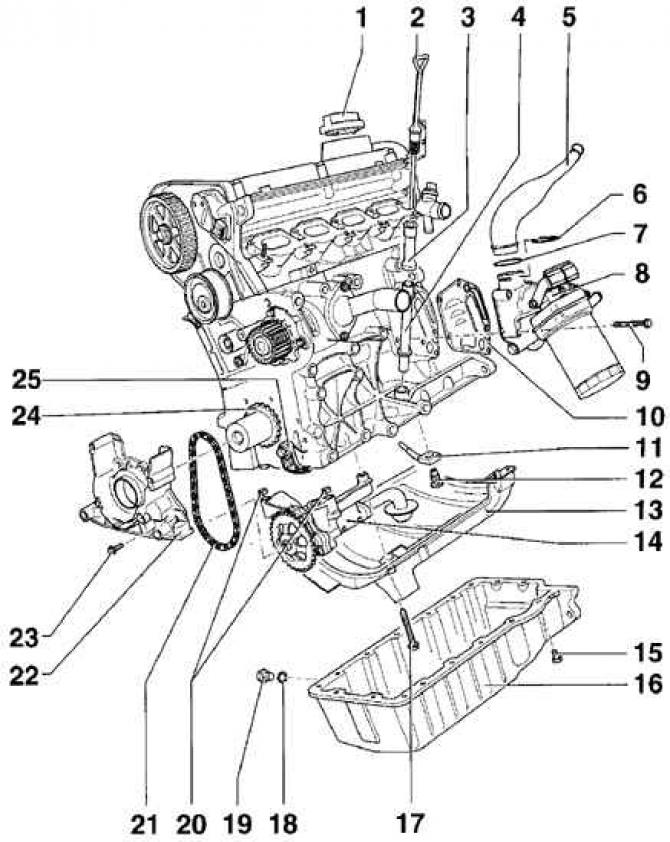
- 1 - oil filler cap. If the cap seal is damaged, it must be replaced;
- 2 - dipstick for measuring oil level;
- 3 - return funnel;
- 4 - guide pipe;
- 5 - connecting pipe. To the air intake sleeve. Only engines 1.8-I;
- 6 - fixing bracket;
- 7 - O-ring. If there is damage, use a new ring;
- 8 - oil filter bracket with heat exchanger and oil filter. Tighten the oil filter by hand;
- 9 - bolt, 25 Nm;
- 10 - corrugated seal (from sheet metal). Use a new seal when installing;
- 11 - oil spray nozzle. Designed to cool the pistons;
- 12 - safety valve; 27 Nm. Valve opening pressure 2.5–3.2 bar;
- 13 - oil deflector;
- 14 - oil pump with chain sprocket;
- 15 - bolt, 15 Nm. Unscrew the bolts with a hinged wrench;
- 16 - oil pan. The oil pan is installed without a gasket on sealant D 176 404 A4;
- 17 - bolt, 15 Nm;
- 18 - O-ring. A new O-ring must be used when installing;
- 19 - oil drain plug, 40 Nm;
- 20 - adapter sleeve. Designed for centering the oil pump;
- 21 - Oil pump drive chain. Before removing the chain, mark the direction of rotation of the chain with paint;
- 22 - gasket. The gasket is installed on sealant D 176 404 A2;
- 23 - bolt, 15 Nm;
- 24 - asterisk;
- 25 - chain tensioner mechanism, 15 Nm
If the oil pressure warning light comes on and a beep sounds while the engine is running, this may be due to the following reasons:
- oil level below normal;
- the presence of a fault in the electrical circuit of the pressure sensor and the control lamp;
- poor oil pump performance;
- too much clearance in the crankshaft bearings.
If the oil pressure warning light comes on while the engine is running, turn off the engine immediately. Use the engine oil dipstick to check the oil level and top it up if necessary. Run the engine at idle speed and check that the oil pressure warning light no longer comes on. You can then continue driving.
If the engine oil level is normal and the oil pressure warning light is on, do not continue driving the vehicle, but have the vehicle towed to a workshop to have the oil pressure checked.
If the oil pressure is normal, check the oil pressure sensor and the sensor electrical circuit.
To check the oil pressure and the oil pressure sensor, you need to use a special pressure gauge into which you can screw the oil pressure sensor.
Execution order
1. Check the engine oil level and top it up if necessary.
2. Warm up the engine to normal operating temperature.
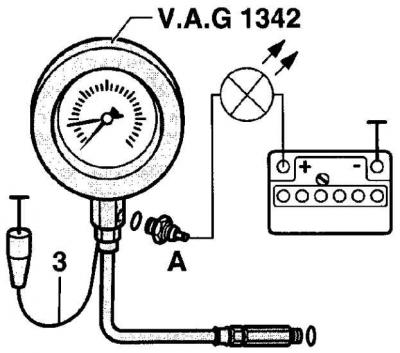
3. Unscrew the oil pressure sensor (A) from the oil filter holder and screw it into the pressure gauge (3 – pressure gauge ground wire).
4. Screw the pressure gauge adapter into the oil filter holder in place of the oil pressure sensor.
5. Connect the ground wire of the pressure gauge to the vehicle ground.
6. Using additional wires, connect the control LED to the positive battery terminal and the oil pressure sensor contact. The LED should light.
7. Start the engine and gradually increase the engine speed. If the excess pressure in 1.4-I petrol engines is 10.3–0.7 bar and in 1.6-/ 1.8-/ 2.3-I engines – 1.2–1.6 bar, the LED should go out. Otherwise, the oil pressure sensor is faulty.
8. Increase engine speed to 2,000 rpm. At an oil temperature of +80°C, the excess oil pressure should be at least 2.0 bar. Lower oil pressure indicates wear of the crankshaft bearings.
9. Continue to increase engine speed further. The oil pressure should not exceed 7.0 bar. Otherwise, the bypass valve is out of order and the oil pump cover with the bypass valve must be replaced.
10. Install the oil pressure sensor with a new sealing ring and tighten it to 25 Nm.
(The information is posted on this website: VWMANUAL.ru)
Visitor comments