



After disassembling the brake saddle, be sure to replace the sealing rings. They are included in the repair kit.
Never attempt to use any piston or cylinder that has worn, nicked or oxidized sliding surfaces, always install the cylinder as an assembly.
Use only brake fluid specified by the standard and never use fluid that is too old.
Lubricate the pistons and sealing rings (cups) with either clean brake fluid or brake grease.
The information is posted on this website: VWmanual
In these brake seats the cylinder body moves on two sliding bushings. The piston is used in the cylinder.
Clamp the cylinder in a vice and remove the dust ring from the cylinder and piston (screwdriver).
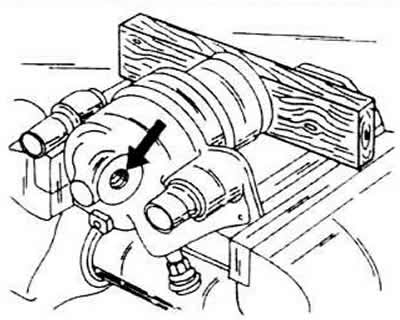
Insert a piece of wood into the recess in front of the piston and use the compressed air supply line to blow the piston out of the hole. Insert the piece of wood. Bring the compressed air line to the place marked with an arrow.
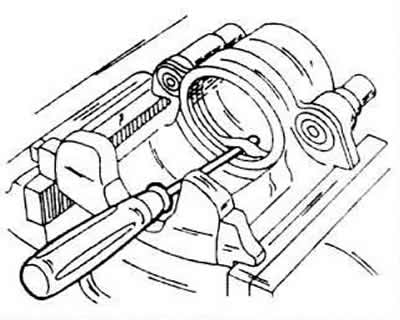
Using a screwdriver, carefully lift the sealing ring located on the inside of the cylindrical hole.
Clean all parts thoroughly and, if the cylinder is in good condition, use the parts from the spare kit for assembly.
Insert a new sealing ring, lubricated with brake fluid or brake grease, into the groove.
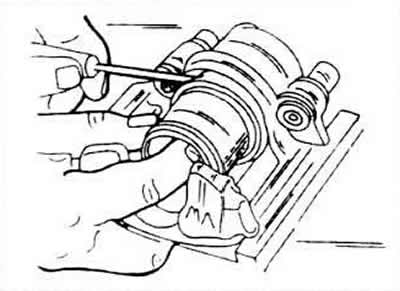
Place the dust ring so that the outer sealing edge faces the piston, and lubricate the piston surface with brake fluid or brake grease.
Place the piston into the cylinder and use a screwdriver to insert the inner sealing lip of the dust ring into the groove of the cylinder.
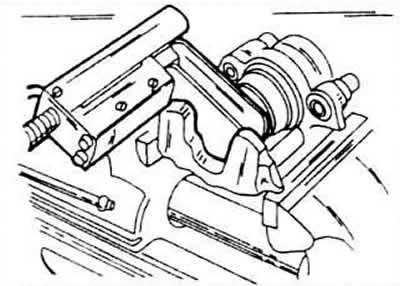
Install a clamp and slowly push the piston into the hole, if there is no clamp, you need to use something similar. You can, for example, try to carefully move the piston with a flat wooden piece.
Visitor comments