



1) the main sensor with a brown housing, which is triggered at P=0.3 kg/cm² (electrical wires black and blue);
2) an additional sensor with a black housing P = 1.4 kg / cm², yellow electrical wires. The control lamp lights up when the engine is idling, when the oil pressure drops below 0.15-0.45 kg / cm². The indicator lamp will also light if the pressure drops below 1.6 kg / cm² at a speed exceeding 2150 rpm, in which case the buzzer will sound. Both sensors are located between the spark plugs in the place shown in Figure 99. The oil pressure in the system is measured using a pressure gauge, which must be equipped with a special nipple for connecting the device instead of the oil pressure sensor. Both sensors should be checked, but the main condition for the checks described below is the presence of a pressure gauge shown in Figure 100 or similar with a sufficient accuracy class.
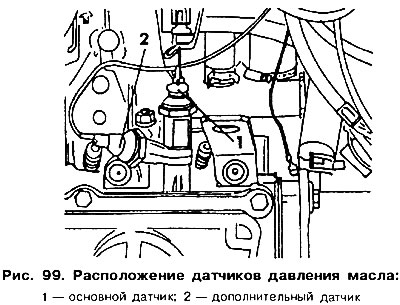
Remove the water terminal from the oil pressure sensor and unscrew the sensor from the engine block head. The sensor is located next to the socket of one of the spark plugs.
Screw the sensor into the pressure gauge and connect the blue wire 1 to it (figure 100).
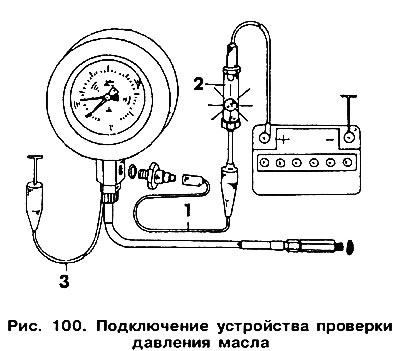
Instead of the sensor, screw a pressure gauge into the cylinder head. Connect the control lamp or electrical "tester" 2 with wire 1 to the additional terminal of the storage battery.
Brown wire 3 short to ground. Turn on the ignition. The indicator lamp should light. If this does not happen, replace the sensor or lamp.
Start the engine and let it idle. Check if the control lamp goes out at a pressure of (0.15-0.45) kg/cm. If it does not go out, replace the sensor.
From sensor 1 (figure 99) disconnect the wire and connect to sensor 2 (to the wire with black insulation).
Increase the engine speed. When it reaches 2000 rpm and the oil temperature is 80°C, the pressure gauge should show an oil pressure of 2 kg/cm². Otherwise, the oil pump must be replaced (if the oil volume in the oil pan is sufficient).
Visitor comments