



Examination (by car)
Visually inspect each strut body for shock absorber fluid leakage. Very slight traces of fluid are acceptable, but excessive loss will result in loss of shock absorber action.
Check the telescopic strut rod - unevenness and scoring on its surface can lead to damage to the seals.
Check the operation of the shock absorber (the stroke of the rod should be smooth throughout, with constant force). Defective shock absorbers produce a characteristic knocking sound when the car moves over uneven surfaces.
Press each corner of the car in turn and release it. If the shock absorber is working properly, the car will return to its original position under the action of the spring and stop. If the car continues to oscillate up and down for some time, then the corresponding shock absorber is faulty.
Replace the rack if there is a defect in the shock absorber. If there is an obvious defect, it is enough to replace one shock absorber - there is no need to change the second one.
Check the shock absorber in more detail by removing the strut from the car (see section "Check - outside the vehicle").
Replacement
1. Loosen the wheel mounting bolts, lift and support the front of the vehicle. Remove the wheel.
2. Loosen the lock nut and release the brake hose from the bracket on the strut body. Do not disconnect the brake hose from the system.
3. Remove the two bolts securing the steering knuckle to the telescopic suspension strut. The top bolt is an eccentric bolt and is used to adjust the camber. A puller is required to remove this bolt. Mark the position of the eccentric bolt (figure M:2). Also mark the position of the eccentric washer installed on the bolt (5, figure M:8).
4. Open the hood and remove the two nuts securing the upper support of the telescopic strut to the inner wing panel.
5. Press the suspension arm down to separate the steering knuckle from the strut assembly and remove the strut assembly from under the fender
6. Compress the spring using two spring compressors (figure M:9).
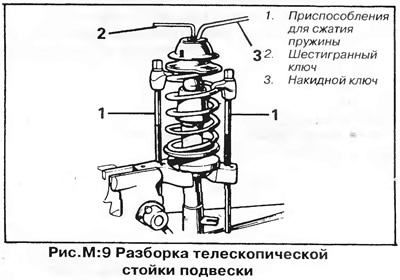
7. Loosen the self-locking nut of the telescopic strut rod, holding the rod with a 7 mm Allen key (figure M:9).
8. Remove the upper support with the bearing and the upper spring plate from the rack (figure M:11), then remove the spring (compressed). Remove the buffer and protective rubber cover from the rod.
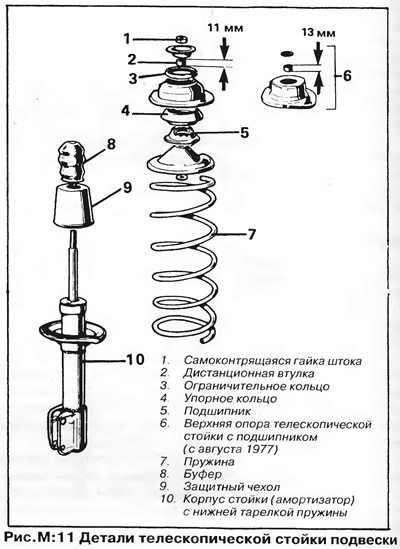
9. Move the removed parts to the new stand (shock absorber).
NOTE: Since 1978, a new type of upper support bearing has been installed. A longer spacer sleeve and a new washer are installed with the new bearing. The new type bearing can be installed on the old strut, provided that the new washer and spacer sleeve are installed at the same time.
10. Tighten the stem self-locking nut to the torque specified in Section "Technical data", then release the spring from the compression devices.
11. Install the telescopic strut on the vehicle in the reverse order of removal.
12. When installing the eccentric bolt with washer, align it with the mark made before disassembly.
13. Tighten all nuts and bolts to the torque specified in the section "Technical data".
14. Check and, if necessary, adjust the toe-in and camber of the front wheels.
Checking the shock absorber (outside the car)
Hold the shock absorber vertically in a vice, then manually extend and retract the piston rod several times. Pull the piston rod out to its full length and push it in again. The resistance to movement should be the same throughout the piston rod stroke, without jerking or jamming. A change or sudden loss of resistance indicates air in the shock absorber, loss of fluid, or a faulty valve.
If the loss of resistance or "springy" feeling occurs early in the stroke, air is present. Leave the shock upright for a few minutes to allow any air bubbles to collect at the top of the shock, then cycle the shock a few short strokes from the fully compressed position, then cycle the shock a few full strokes to remove any air from the chamber. Repeat the test.
If resistance remains weak or uneven, replace the shock absorber.
Visitor comments