



Contents: Checking the electrolyte level ↓ Operation in winter conditions ↓ Charging the battery ↓ Removal the battery ↓ Installing the battery ↓ Purchasing a battery ↓
A battery is a device for storing energy in a chemical form that can be used as electricity.
The battery works because two different metals, when placed in an acidic solution, generate electricity.
The battery is 100% efficient at 27°C. At -18°C, the efficiency of the same battery drops to 40%. Now, in order to start the engine, you need to have more than twice as much energy as was needed at 27°C.
Starting power (starting amperes) shows the battery's ability to start a vehicle in very cold weather conditions. It shows the amount of amperes the battery can produce for 30 seconds at -18°C without the voltage dropping below 7.2 volts (the minimum level required for a reliable start). The higher this figure, the greater the starting power of the battery.
The reserve capacity indicates the length of time in minutes that the battery supplies 25 amps at 27°C. This factor represents the time that the battery supplies all accessories in the vehicle at night and in bad weather conditions with a faulty charging alternator.
In winter conditions at -18°C and below, the battery will charge poorly due to the increase in internal resistance. During short trips in winter, the energy expended by the battery for starting is not compensated. As a result, the battery wears out, constantly discharges and eventually fails.
During the summer months, after long journeys, the engine becomes very hot and often difficult to restart. These "hot starts" sometimes require as much power as in cold weather, or more. This is especially true for high-compression, large-displacement engines and cars with air conditioning. This again highlights the importance of choosing the right battery for the car's engine.
Warning: Work must be done with protective glasses. Do not allow acid drops or particles containing lead compounds to come into contact with eyes, skin or clothing.
Warning: The electrolyte is very aggressive. Use protective gloves and glasses. Do not tilt the battery - electrolyte may spill out of the ventilation holes. If the electrolyte gets into your eyes, rinse your eyes immediately with clean water for several minutes. Then consult a doctor immediately. If the electrolyte gets on your skin or clothes, neutralize the acid with alkaline soap immediately and rinse the affected area with plenty of clean water. If the electrolyte accidentally gets inside your body, consult a doctor immediately.
Warning: When charging batteries, an explosive gas mixture is released.
Warning: When working with wires and electrical devices, it is prohibited to use fire, sparking devices, open fire-hazardous lighting devices and smoking. Sparking should be avoided when handling wires and electrical devices. Never short-circuit the battery terminals directly: there is a high risk of injury due to strong sparking.
Warning: Before performing any work on the vehicle's electrical system, disconnect the negative cable from the battery. When replacing incandescent bulbs, simply turn off the corresponding switches.
Warning: When disconnecting the battery from the vehicle's electrical system, disconnect the negative cable first, then the positive cable. Do not disconnect the battery while the engine is running, otherwise the electronic devices of the electrical system will be damaged.
Warning: When installing the battery in a vehicle, connect the positive cable first, then the negative cable.
Warning: To protect the battery case from ultraviolet radiation, do not store the battery in direct daylight.
Checking the electrolyte level
Location of marks for checking the electrolyte level in the battery
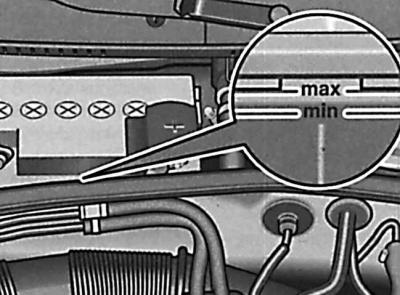
The battery under normal vehicle operating conditions requires almost no maintenance. At high ambient temperatures, it is recommended to check the electrolyte level in the battery from time to time. You should also check the electrolyte level when charging the battery. It should always be between the MIN and MAX marks on the longitudinal sides of the battery, see Fig. Location of marks for checking the electrolyte level in the battery.
When the electrolyte level drops, add distilled water to the appropriate jars up to the MAX mark. This should be done before the electrolyte drops below the MIN mark.
Do not fill the electrolyte above the required level, otherwise the electrolyte will leak out through the ventilation hole. This may cause damage to the paintwork and corrosion of the body.
After adding electrolyte, the corresponding battery jars should be tightly closed with plugs.
Operation in winter conditions
In winter, the battery is under particularly heavy load. In addition, at low temperatures, the battery only provides a portion of the power it has at positive temperatures when starting the engine. Therefore, we recommend checking the battery before the winter season and recharging it if necessary.
If the car is not used for several weeks during very severe frosts, the battery should be removed and stored in a heated room so that it does not freeze and, as a result, is not destroyed.
Charging the battery
Before charging, turn off the ignition and all current consumers.
When charging with a small current (for example, using a low-power charger), there is generally no need to disconnect the connecting wires of the on-board electrical system. In any case, it is necessary to follow the instructions of the charger manufacturer.
Before boost charging, which means charging with a high current, both wires connecting the battery to the on-board electrical system should be disconnected from the battery.
We recommend that you do not install a battery that has once frozen and thawed back into your vehicle, as the battery monoblock may have cracks inside due to ice forming when the battery freezes.
If the battery was disconnected from the vehicle's electrical system and then reconnected to it.
When you disconnect the battery from the vehicle's electrical system, keep in mind that:
- all data from the trip computer's memory device is erased;
- all data from the driver's seat memory device is erased;
- watches with hands stop, watches with digital indication are out of order;
- the factory installed receiver is blocked;
- the automatic raising and lowering of the windows with electric windows does not work.
(The article is posted on this website www.vwmanual.ru)
After connecting the battery to the vehicle's electrical system, you should re-set the clock with both the pointer and digital display.
Next, you should restore the functioning of the automatic full raising and lowering of the windows.
In addition, you must re-initialize the driver's seat memory, otherwise the adjustments will not be remembered.
The factory-installed radio can only be made operational by entering the appropriate code – see the Radio User's Guide.
Removal the battery
1. Before removing the battery, turn off the ignition and disconnect all power consumers.
2. To remove the battery, first disconnect the negative cable (in most cases black or brown in color).
3. The positive battery terminal is protected by a cover. Open the cover and then disconnect the positive cable (in most cases red).
4. Unscrew the battery mount and remove it.
Installing the battery
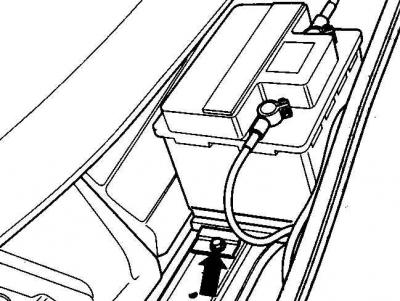
1. Place the battery in its designated place and secure it with a bolt.
2. When connecting the battery, connect the positive cable first (in most cases red) and then the negative wire (in most cases black or brown in color).
3. The positive battery terminal is protected by a cover. Close the cover.
Purchasing a battery
Probably the most important thing that a buyer should pay attention to is the battery characteristics. There are three of them. The first is the nominal voltage, it is the same for all batteries, and it is impossible to make a mistake. When buying, it is advisable to check the battery with a load fork. The second is the capacity, measured in ampere/hours (A/h), which means, roughly speaking, the amount of electricity stored in the battery. The capacity determines how long the starter can turn the engine, or more precisely, how many attempts can be made to start the engine. The price of the battery is almost directly proportional to its capacity. And the third characteristic is the starting current (measured in amperes, A), i.e. the current supplied to the starter during starting. On batteries it can be indicated according to four different systems: GOST (on domestic), EN (standard of the United Europe), SAE (american standard) and DIN. The latter, the German standard, is the closest to our GOST and is installed on most European batteries "by default", i.e. when the standard system is not specified. The larger it is, the faster and with greater force the starter will turn the engine.
It is better if you buy a battery with the characteristics specified in the operating instructions for your car: this way it will serve you longer with minimal expenses. You can save money and buy a battery with a smaller capacity, but it will serve you less than the usual period and will not cope well with winter starting. Even if you buy a battery with a slightly larger capacity, you will not win in service life, since constant undercharging of the battery will lead to sulfation of the plates, and you will lose money. You should also not get carried away with increased starting current: you will burn out the starter. It is better to change the oil in the engine, and there will be no problems with starting.
Recently, the country's market has been overflowing with low-quality goods and fakes. Batteries are no exception. There are several signs by which you can distinguish the original from a fake with sufficient accuracy. First and perhaps most important: the country of manufacture and the manufacturing plant must be indicated on the battery, preferably with the address. Second, the date of manufacture must be indicated, which is very important if the battery is flooded. Each battery must be accompanied by a technical passport, but the presence of instructions is not required. This is due to the fact that in the West, batteries are almost never sold at retail; they are installed by specialists at service stations. Third, a high-quality battery is unthinkable without a high-quality case, good plugs and smooth terminals, often lubricated with technical protective grease from oxidation and covered with colored plastic caps on top.
Visitor comments