
English Русский
Български
Беларускі
Український
Српски
Hrvatski
Română
Polski
Slovenský
Magyar
  |  Articles  |  Sitemap  |  Contacts  |    |
Car maintenance Ford Car maintenance Hyundai Car maintenance Chevrolet Car maintenance BMW Car maintenance Audi Car maintenance Opel Car maintenance AvtoVAZ
VWmanual.ru


Main   Passat   Golf   Polo   Touareg   Tiguan   Sharan   Transporter   Others  
Golf 1 (1974-1984, diesel) Golf 1 (1974-1984, petrol) Golf 2 (1984-1993, petrol) Golf 2 (1984-1993) Golf 3 (1991-1997) Golf 4 (1997-2004) Golf 5 (2003-2008)

Engine management system (VW Golf 4)

  • Main
  • Golf
  • Golf 4
  • Power unit
  • Control system (petrol)
  • Engine management system
            0


Location of SIMOS engine management system components in the engine compartment with 1.6-I engine
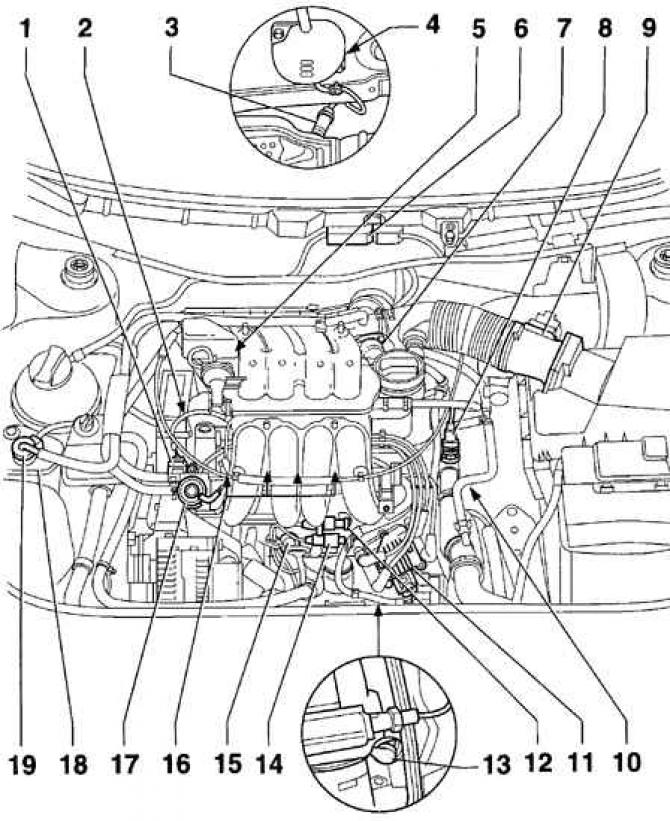


Location of SIMOS engine management system components in the engine compartment with 1.6-I engine

  • 1 - Hall sensor electrical connector (black);
  • 2 - Hall sensor. On the upper casing of the toothed belt;
  • 3 - Lambda sensor, 50 Nm. Mounting position with automatic transmission in the exhaust manifold;
  • 4 - Lambda sensor electrical connector. On the bottom of the car, on the right;
  • 5 - intake manifold switching valve;
  • 6 - SIMOS control unit;
  • 7 - throttle body;
  • 8 - coolant temperature sensor;
  • 9 - air flow meter. With a temperature sensor for the air entering the engine;
  • 10 - place of connection of the ground bus to the gearbox;
  • 11 - ignition coils. With ignition control unit;
  • 12 - electrical connector of the knock sensor;
  • 13 - engine speed sensor;
  • 14 - Electrical connector of the engine speed sensor (gray);
  • 15 - knock sensor;
  • 16 - fuel injectors;
  • 17 - fuel pressure regulator;
  • 18 - Canister with charcoal;
  • 19 - Magnetic valve of the charcoal canister

Various engine management systems are installed on cars with gasoline engines.

EngineEngine management system
Engine 1.4-IAHW/ AKQ Magneti Marelli 4AV
Engine 1.6-IAEH/ AKL Simos 2
Engine 1.8-IAGN Motronic 3.8.5
Engine 1.8-ITurbo AGU Motronic 3.8.3
Engine 2.3-IAGZ Motronic 3.8.3


The use of an electronic engine management system has the following advantages:
  • ensures optimal fuel supply to the engine in all operating modes, resulting in reduced fuel consumption while maintaining the vehicle's dynamic performance;
  • due to more complete combustion of fuel, as well as the use of a catalyst, the emission of harmful substances along with exhaust gases is reduced;
  • since the electronic engine management system detects and records faults in its memory, troubleshooting and detection is significantly accelerated;
  • the engine management system sets the optimal ignition timing, moment and amount of fuel supplied to the engine in all operating modes. The engine management system also interacts with other vehicle systems, in particular, with the automatic transmission control system or with the anti-theft system.

The engine management system components are very reliable and require virtually no maintenance. Maintenance only requires replacing the air filter and spark plugs. Since complex, expensive equipment is required to check, adjust, and repair the engine management system, this work must be performed at a specialized service station.

During vehicle operation, there is no need to adjust idle speed or CO content in exhaust gases.

Warning: When working on the ignition system with the ignition on, be careful because you may receive an electric shock from the high-voltage part of the ignition system. People with pacemakers are not recommended to check or repair the engine management system. Turn off the ignition before disconnecting or connecting any component of the ignition system or test leads.


(The text is copied from this portal: «vwmanual»)

Warning: The fuel system is under constant pressure even after the engine is turned off, so before performing any work on the fuel system, the pressure must be relieved.


Warning: To prevent the possibility of accidental electrical short circuits and damage to electronic components of the engine management system, always remove the ground cable from the battery.


Before performing any work on the engine management system, recall the faults stored in it from memory. Also check the fuel system and the engine air supply system for leaks.

Normal operation of the engine management system is possible only when the voltage in the vehicle's network is not lower than 11.5 V.

If after work on the engine management system the engine starts and stops after a short time, the engine may be switched off by the anti-theft system. In this case, recall the faults stored in the memory and, if necessary, adjust the engine management system.

This article is available at russian, bulgarian, belarusian, ukrainian, serbian, croatian, romanian, polish, slovak, hungarian
The text has been checked: Kolesnikov Artem

Share information:

Previous articles
Next articles
Technical data of the engine management system
Operation of the engine management system
Checking the fuel injection system
Sensors and actuators of the engine management system
Ignition system
Ignition coil device


Similar articles from other manuals for VW cars:
Engine management system Motronic, alarm Passat B5 (1996-2005)
Operation of the gasoline engine management system Polo 4 (2001-2009)
Pressure testing of the cooling system (petrol engine) Touareg 1 (2002-2006)
Cooling system parts and components installed on the engine Tiguan 1 (2007-2015)
Diesel Engine Cooling System — General Information Sharan 1 (1995-2000)
Engine and exhaust system Transporter T4 (1990-2003)
Engine management system AGX 2.5 TDI from November 1997 (I).… LT 2D (1996-2003)
Link to this page in different formats


Visitor comments


No comments yet


How much will 10 + 40 =


Golf 5 
  • General information
  • User manual
  • Maintenance
  • Troubleshooting
  • Power unit
  • Engine repair
  • Cooling and ventilation system
  • Fuel system
  • Ignition system
  • Transmission
  • Clutch
  • Mechanical gearbox
  • Automatic gearbox
  • Chassis
  • Brake system
  • Car suspension
  • Steering
  • Body
  • Interior (internal elements)
  • Exterior (external elements)
  • Doors and covers
  • Electrical equipment
  • Power devices
  • Washers and wipers
  • Lighting and appliances
  • Electrical circuits
Golf 4 
  • General information
  • User manual
  • Weekly checks
  • Maintenance
  • Power unit
  • Petrol engines
  • Diesel engines
  • Cooling system
  • Fuel system (petrol)
  • Control system (petrol)
  • Fuel system (diesel)
  • Exhaust system
  • Transmission
  • Clutch
  • Car gearbox
  • Drive shafts
  • Chassis
  • Car suspension
  • Steering
  • Wheels and tires
  • Brake system
  • Body
  • Exterior (external elements)
  • Interior (internal elements)
  • Ventilation and heating
  • Car doors and sunroof
  • Washers and glass cleaners
  • Electrical equipment
  • Power devices
  • Lighting and appliances
  • Electrical circuits
Golf 3 
  • Petrol engine
  • Engine repair
  • Lubrication system
  • Cooling system
  • Ignition system
  • Diesel engine
  • Engine repair
  • Diesel injection system
  • Pre-glow system
  • Transmission
  • Clutch
  • Gearbox and drive shafts
  • Chassis
  • Steering
  • Wheels and suspension
  • Brake system
  • Electrical equipment
  • Lighting and appliances
  • Electrical circuits
Golf 2 
  • General information
  • Introduction to guide
  • User manual
  • Petrol engines 1.3 l
  • Engine repair
  • Lubrication system
  • Cooling system
  • Carburetors
  • Supply system
  • Ignition system
  • Petrol engines 1.6/1.8 l
  • Engine repair
  • Supply system
  • Ignition system
  • Diesel engines
  • Engine repair
  • Lubrication system
  • Cooling system
  • Power and exhaust system
  • Transmission
  • Clutch
  • 4-speed gearbox 084
  • 5-speed gearbox 085
  • 4-speed gearbox 020/4R
  • 5-speed gearbox 020/4T
  • Automatic gearbox
  • Drive shafts
  • Chassis
  • Steering
  • Car suspension
  • Brake system
  • Body
  • Body elements
  • Doors, locks and windows
  • Electrical equipment
  • Equipment and devices
  • Power devices
Golf 2 (petrol) 
  • General information
  • Characteristics
  • Car care
  • Maintenance
  • Power unit
  • Engine repair
  • Engine 1.05/1.30
  • Engine 1.60/1.80
  • Cooling and lubrication system
  • Power and exhaust system
  • Transmission
  • Clutch
  • Car gearbox
  • Drive shafts
  • Chassis
  • Brake system
  • Steering
  • Suspension
  • Body
  • Body and equipment
  • Electrical equipment
  • Lighting and appliances
  • Electrical circuits
Golf 1 (petrol) 
  • General information
  • Characteristics
  • User manual
  • Maintenance
  • Power unit
  • Engine adjustment
  • Engine 1.1/1.3
  • Engine 1.5/1.6/1.8
  • Engine electrical equipment
  • Cooling system
  • Fuel system
  • Transmission
  • Clutch and manual gearbox
  • Automatic gearbox
  • Chassis
  • Steering
  • Front suspension
  • Rear suspension
  • Brake system
  • Electrical equipment
  • Lighting and appliances
  • Electrical circuits
  • Body
  • Body and equipment
  • Optional equipment
Golf 1 (diesel) 
  • General information
  • Specifications
  • Maintenance
  • Power unit
  • Engine repair
  • Exhaust and turbocharger
  • Cooling system
  • Fuel system
  • Fuel injection system
  • Transmission
  • Clutch and drive shafts
  • Car gearbox
  • Chassis
  • Suspension and wheels
  • Steering
  • Brake system
  • Wheels and tires
  • Body
  • Heating and ventilation
  • Exterior (external elements)
  • Interior (internal elements)
  • Doors and windows
  • Electrical equipment
  • Equipment and devices
  • Lighting system
  • Power devices
  • Electrical circuits
VWmanual.ru © 2016-2026 | Mobile version | News and articles | Sitemap: EN BG BY UA RS HR RO PL SK HU | Write message | Site search
Passat B2 • Passat B3 • Passat B4 • Passat B5 • Passat B6 • Golf 1, diesel • Golf 1, petrol • Golf 2, petrol • Golf 2 • Golf 3 • Golf 4 • Golf 5 • Polo 3 • Polo 4 • Touareg 1 • Tiguan 1 • Sharan 1 • Transporter T3 • Transporter T4 • LT 28 • LT 2D • Beetle • Caddy 3 •
Our website uses cookies to ensure functionality and convenience.