



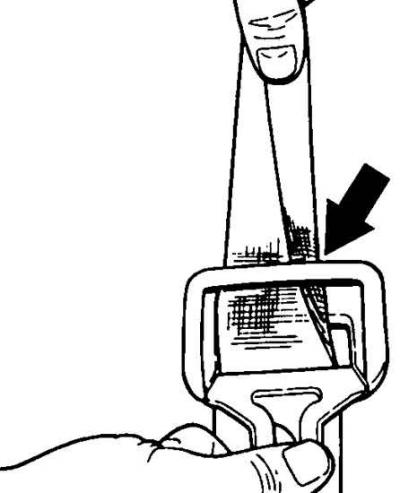
Checking the seat belt for broken threads or fraying
Warning: Do not use the power shoulder belt from the emergency kit on a child seat. The diagonal belt does not provide adequate protection.
Belts, buckles and fastenings should be inspected periodically and checked for proper operation. If belts are removed for any reason, they must be installed correctly.
Warning: To ensure proper operation of the tensioner mechanism, keep the seat belts clean. If the buckles or tensioner mechanism are damaged, replace the belts.
Warning: Belts that have been severely stretched in an accident should be replaced.
Warning: When exposed to sunlight and chemicals, the belt tape will lose strength. When the original color is lost (fading) the belt should be replaced.
Warning: Wash the belts only in a mild soap solution. Dry the belts thoroughly before retracting them.
Warning: Do not treat, tint, or discolor the belt webbing with chemicals. Chemicals will weaken the belt. A belt that is discolored or weakened by chemicals should be replaced.
Warning: Always replace belts as a set. Do not install buckles or tensioners that are not designed for this seat or from other vehicles.
Execution order
1. Make sure the belts are not twisted due to improper installation. If the belts are twisted or stick when retracted, pull the belt out as far as it will go to straighten it. Then return the belt to its original position.
2. Pull the belt out completely and release it so that it is completely retracted. If the belt sticks when moving in both directions, check it for cleanliness, dirt, grease and other foreign matter on the webbing. The belt should be washed only with a weak water and soap solution. If the belt cannot be washed with this solution, it should be replaced.
3. Check the condition of all belt attachment points. The mounting bolts must be securely tightened. Remove any traces of corrosion in the places where the belt is attached to the body. Replace any corroded fastening parts.
4. The belt should also be replaced if the following damage is detected:
- thread breaks or fraying (see picture Checking the seat belt for thread breaks or fraying),
- cuts in the loops on the edges of the belt,
- curvature of the tape,
- the presence of painted areas or cuts.
5. The belt assembly should be replaced if the following damage is detected:
- the belt buckle is not securely fastened,
- the belt release button has come loose,
- the buckle won't release the belt,
- the force required to release the belt has increased,
- there are cracks on the surface of the buckle.
Visitor comments