



Contents: Removal ↓ Installation and tensioning ↓
Removal
CAUTION: When performing all installation work, particularly in the engine compartment due to the tight layout, pay attention to the following: lines of all types (for example fuel, hydraulic, activated carbon canister, cooling systems, refrigerant, brake lines, vacuum hoses), and electrical wires must be laid as they were originally laid. Provide sufficient clearance to all moving and hot components to avoid damage to any kind of lines.
Remove the noise insulation screen.
Remove the fan bracket together with the cooling system fans.
Place the radiator frame in the service position.
Mark the direction of the poly V-belt and remove it.
Remove the right and left timing belt covers.
Mark the direction of rotation on the timing belt with a waterproof marker.
Bring the crankshaft to top dead center. The mark on the timing belt cover A should coincide with the notch on the belt pulley B.
Check the position of the camshaft gears. Large holes in the mounting plates (fig. 2.106) must be located opposite each other on the inside.
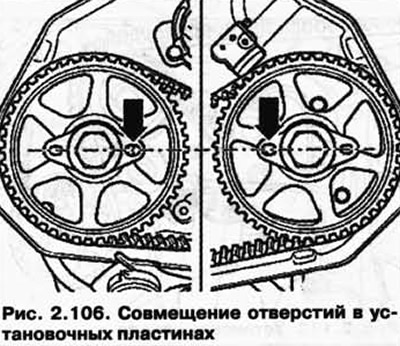
NOTE: If the large holes are located on the outside of the gears, it is necessary to rotate the crankshaft one more revolution in the direction of engine rotation.
Unscrew the threaded plug on the left from the cylinder block (fig. 2.100). The TDC hole of the crankshaft should be visible behind the hole of the threaded plug and can be felt by touch.
Carefully screw the locking bolt 3242 into the hole until it stops and thus fix the crankshaft from turning.
Remove the middle timing belt cover.
Unscrew the vibration damper.
NOTE: The vibration damper is secured to the crankshaft with 8 bolts.
First, unscrew bolt 1 from the oil filter housing, then bolts 2 from the timing belt tensioner cover (fig. 2.107).
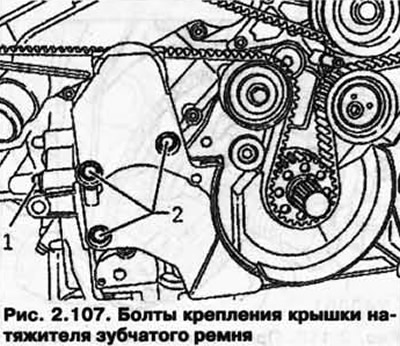
Remove the cover.
NOTE: The timing belt tensioner has an oil choke. Therefore, it compresses slowly.
NOTE: Use T40011 locking pin to secure the tensioner.
NOTE: If necessary, align the holes in the housing and on the tensioner piston before tensioning using needle-nose pliers or thin wire.
Turn the timing belt tension roller lever 1 with an internal hexagon in the direction (fig. 2.108).
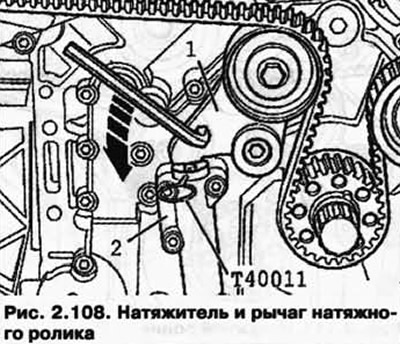
After the lever compresses tensioner 2 so that the holes in the housing and piston are opposite each other, secure the tensioner with locking pin T40011.
Insert the T4000 camshaft clamp into the camshaft mounting plates and loosen the mounting bolts approximately 5 turns (fig. 2.109).
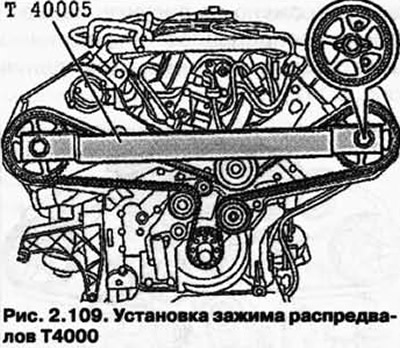
Remove the T40005 camshaft clamp.
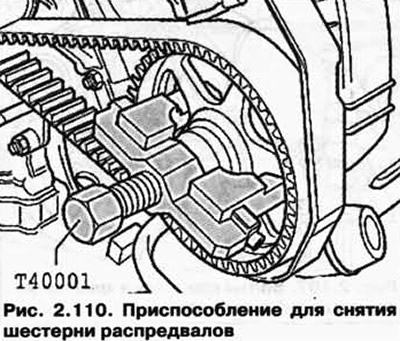
After this, using the two-handed puller T40001 and the hook T40001/2, remove the camshaft gears from the cone (fig. 2.110).
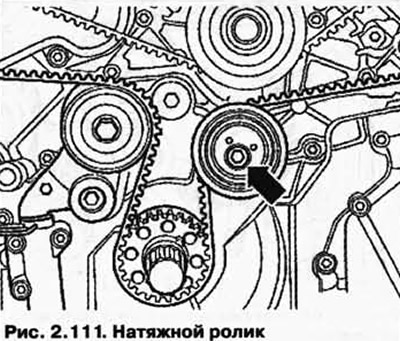
Unscrew the tension roller (see fig. 2.111) and remove the timing belt.
Installation and tensioning
NOTE: If the belt has been used previously, pay attention to the direction of rotation mark.
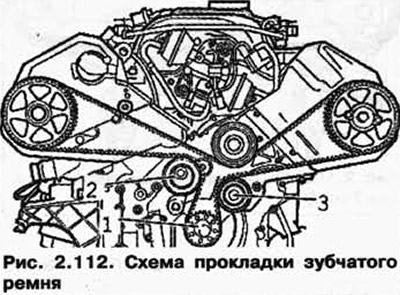
First lay the toothed belt on the crankshaft gear 1, then on the tensioner idler pulley 2 and then on the tensioner pulley 3. Then, as shown in the figure, on the camshaft gears and the belt pulley of the coolant pump (fig. 2.112).
NOTE: The camshaft gears should still spin a little on the camshaft cones.
Reinstall the T40005 camshaft clamp onto the gears.
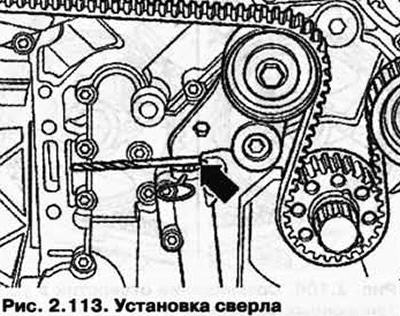
Place a 5mm drill bit between the tensioner arm and the tensioner piston (fig. 2.113).
Tighten the still loose tension roller with the VAG 1410 torque wrench with the VAS5122 ratchet and the T40009 tension roller key counterclockwise (fig. 2.114) with a tightening torque of 4 Nm.
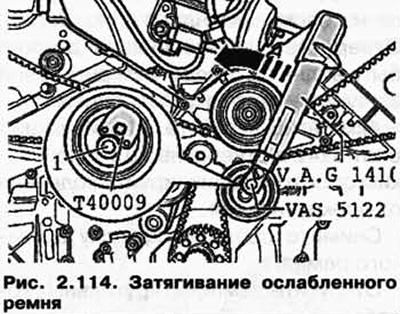
In this position Tighten bolt 1 to 22 Nm.
After this, remove the 5mm drill bit.
Turn the timing belt tension roller lever 1 with an internal hexagon in the direction (fig. 2.114).
After the lever compresses the piston in the timing belt tensioner 2, remove the locking pin T40011.
Turn the timing belt tension roller lever 1 with an internal hexagon in the direction (fig. 2.115) and place a 7mm drill between the body and the lever.
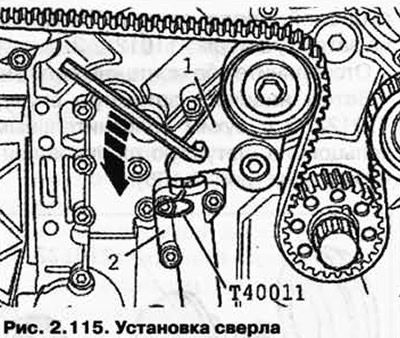
Tighten the camshaft gears to a tightening torque of 55 Nm.
Remove the camshaft clamp - T40005.
Remove the drill bit inserted between the housing and the tension lever again.
Unscrew the fixing bolt 3242 from the hole, screw in the threaded plug (fig. 2.101) and tighten it to 30 Nm.
Rotate the crankshaft twice in the direction of engine rotation and check the installation dimension A (fig. 2.116). The specified value is 5 mm.
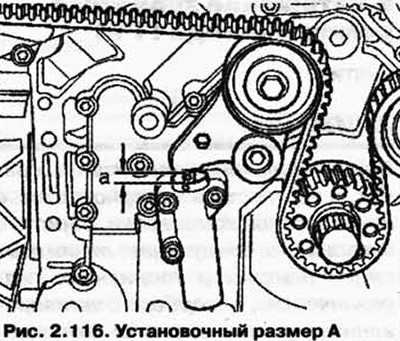
Further installation is carried out in reverse order.
Visitor comments