



With timely maintenance, vehicle defects and malfunctions that affect its durability and road safety can be promptly identified and corrected. In addition, regular checks significantly contribute to maintaining the proper performance and driving characteristics of the vehicle.
Depending on operating conditions, different requirements are imposed on motor oils. Therefore, it is very difficult to accurately predict the consequences of the effects of various conditions on oil. In engines that operate at high speeds or under full load for long periods of time, the oil heats up to high temperatures. Under the influence of it and the oxygen contained in the air, the oil begins to oxidize. Oxidation products thicken the oil and can deposit as a varnish-like film on the tops of pistons, in piston ring grooves and on valve guides.
If the engine cylinders receive an over-enriched fuel mixture, and high engine loads are rare or absent altogether, or if the engine is operated in a nearly cold state (city driving), the consequence of this is incomplete combustion of fuel. Soot, oil deposits, unburned fuel and water condensation lead to the formation of deposits, acids and other harmful products. Unburned fuel flows down the walls of cold cylinders and enters the oil sump. The consequence of this is deterioration of piston lubrication and dilution of the oil, which, in turn, reduces the quality of the oil due to the presence of gasoline in it. If the oil is thinned to an excessive degree, it must be replaced earlier than the prescribed time. Since gasoline components in the oil evaporate under extreme engine operating conditions, the oil level should be checked more frequently, especially in winter (since the numerous attempts to start a cold engine usually result in an increase in the gasoline content in the oil).
Every engine consumes oil. Normal oil consumption for VW Kafer engines is approximately 0.5 l per 1000 km. The engine wear limit is indicated by oil consumption of more than 1 liter per 1000 km.
Depending on the temperature, the viscosity of the oil also changes. As the temperature increases, the oil liquefies. This reduces the thickness and strength of the oil film. In cold weather, it thickens and becomes more viscous, increasing friction. In this regard, it is preferable to use a motor oil whose viscosity changes little with temperature changes.
In a cold engine, the oil must be thin enough to not impede the starter's operation, and so that when the engine is running, the oil reaches all lubricated areas as quickly as possible.
The viscosity of an oil is equivalent to its internal friction, and its degree is expressed by the SAE system indicators (Society of Automotive Engineers): for example, SAE 30, SAE 10, etc. A high SAE rating indicates high viscosity, a low rating indicates low viscosity. However, viscosity does not determine the lubricating properties of oils. Both seasonal and all-season oils can be used for the engines of the vehicles described. Preference should be given to all-season ones, as they are suitable for a wide range of ambient temperatures.
All-season oil is made from regular oil (for example, 20W), to which so-called thickeners are added. They stabilize the oil at high temperatures, so the required lubricating properties are achieved under any operating conditions. If all-season oil is used, modern oils with a wide viscosity range should be selected (for example 20W-40, 15W-50).
Oils with anti-friction additives are multigrade oils that, along with other additives, reduce the coefficient of friction, resulting in fuel savings of approximately 3%. When purchasing oil with such additives, ensure that it meets the TL-VW 500 00 standard.
In VW Kafer car engines, HD type oils, improved with various additives, should be used. Additives provide greater resistance to corrosion and oxidation, have a lower tendency to form slags, and greater self-cleaning and deposit-dissolving properties.
Solvents and cleaning additives not only reduce carbon deposits in the engine, but also break down carbon deposits and other contaminants, which are then washed out when the oil and oil filter are changed.
The quality of motor oils is determined by the API system (American Petroleum Institute). This system has also been adopted by European manufacturers. The designation consists of two letters. The first letter indicates the area of application:
- S (Service) - oil is used for gasoline engines;
- WITH (Commercial) - oil is used for diesel engines.
The second letter indicates the quality of the oil (in alphabetical order). The highest quality oils currently available are class SJ for gasoline engines and class CG for diesel engines. There are also oils that are suitable for both gasoline and diesel engines. In this case, two designations are provided on the oil packaging (for example, "SF/CD").
Volkswagen recommends using only engine oils for Kafer vehicles that meet at least one of the following standards: oils with anti-friction additives (VW-500 00), oils for high-performance engines (VW-500 00 and VW-505 00), all-season oils (VW-501 01). Oils that meet the above standards are usually inexpensive. But if it is not possible to purchase oil that meets the VW standard, you can temporarily use regular or all-season oil with API SF quality.
The following classification of oils by viscosity applies to all Kafer vehicle variants described in this manual.
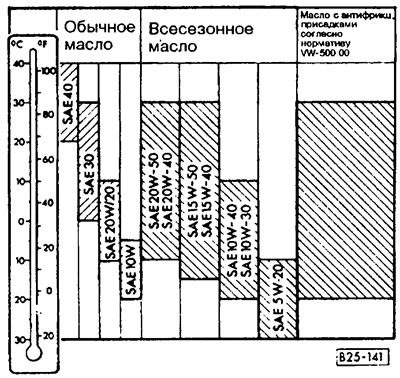
Since the temperature ranges for use of adjacent SAE classes overlap, short-term temperature fluctuations can be ignored. It is permissible to mix oils of different viscosity grades if the ambient air temperature no longer corresponds to the viscosity grade of the oil in the engine.
If the ambient temperature is constantly below -20°C, it is recommended to use SAE 5W-20 oil.
When using oils starting from SAE 10 or SAE 5W-20, prolonged engine operation at high speeds when the temperature exceeds the limit corresponding to the viscosity grade should be avoided.
Please note: All-season SAE 10W-50 oil is not permitted for use in these vehicles
Caution! Active lubricating additives, regardless of type, are not permitted to be added to fuel or lubricants.
Visitor comments