



Elements of the cooling system of the 1.8-I petrol engine
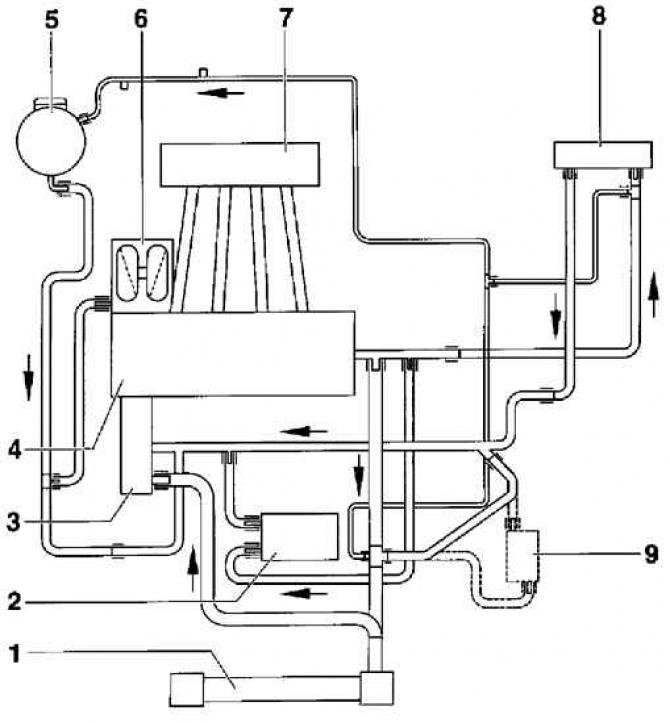
- 1 - radiator;
- 2 - oil heat exchanger;
- 3 - water pump/thermostat;
- 4 - cylinder head/block;
- 5 - expansion tank;
- 6 - turbocharger;
- 7 - intake manifold;
- 8 - heater radiator;
- 9 - Automatic transmission radiator
Elements of the cooling system of a diesel engine
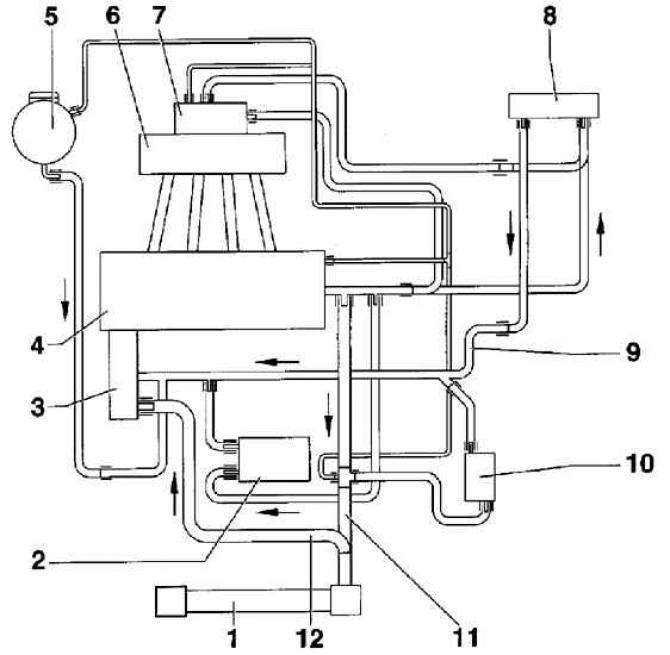
- 1 - radiator;
- 2 - oil heat exchanger;
- 3 - water pump/thermostat;
- 4 - cylinder block;
- 5 - expansion tank;
- 6 - intake manifold;
- 7 - Exhaust gas recirculation radiator. Only ALH engines with automatic transmission;
- 8 - heater radiator;
- 9 - middle pipe of the cooling system;
- 10 - heat exchanger for cooling transmission oil;
- 11 - upper radiator hose,
- 12 - lower radiator hose
The sealed cooling system includes a water pump, radiator fan, radiator, expansion tank, thermostat and heater core, as well as hoses and switches. When starting a cold engine, coolant circulates around the cylinder block and cylinder head. Warm coolant passes through the heater core to the water pump. As the coolant expands when heated, its level in the expansion tank rises. The coolant flow through the radiator is closed, which ensures a closed thermostat. When the coolant reaches a predetermined temperature, the thermostat opens and the hot coolant passes through the hose to the radiator. As the coolant passes through the radiator, it is cooled by the oncoming air flow. When the coolant temperature is between +92°C and +98°C, the temperature sensor turns on the first stage of the radiator fan and the fan rotates at a reduced speed. When the coolant temperature is from +99°C to +105°C, the temperature sensor switches the radiator fan to the second stage and the fan rotates at maximum speed.
An electrically driven fan may turn on even after the ignition is turned off. Therefore, when working on a hot engine, it is necessary to disconnect the electrical connector from the fan motor for the duration of the work.
Warning: When opening the expansion tank cap on a hot engine, care must be taken as escaping vapors can cause severe burns. To do this, cover the expansion tank cap with a thick layer of cloth and slowly unscrew the cap until a hissing sound is heard. After the hissing stops, slowly unscrew and remove the cap from the expansion tank.
Warning: Do not allow coolant to come into contact with clothing or paintwork. If it does, rinse the surface with plenty of water.
View the original on this portal: www.VWManual.ru
Visitor comments