



Exhaust system and turbocharging
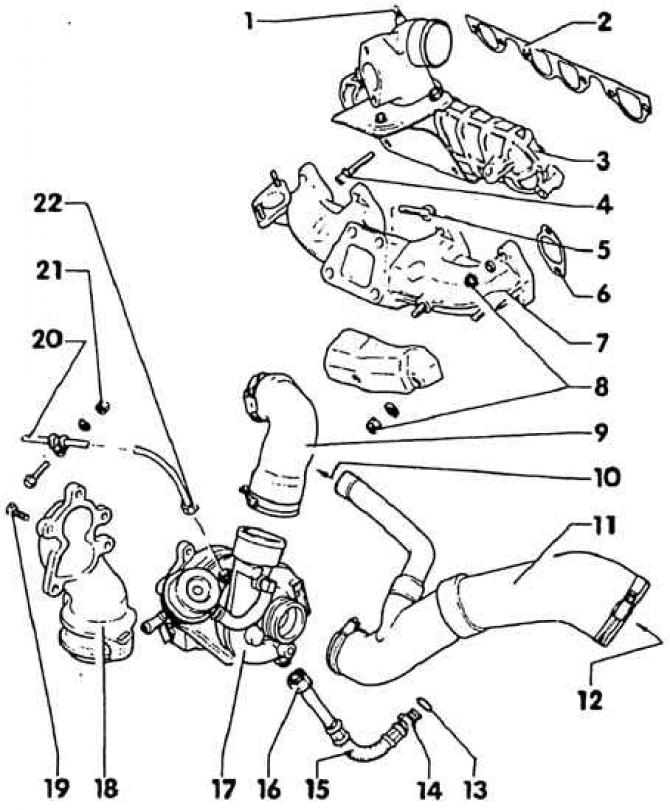
1. Connecting tube - with a plug for checking the boost pressure; 2. Gasket - the coating (thickening) indicates the intake pipe; 3. Intake pipe - with connection for return flow of exhaust gases; 4. Bolt, 25 Nm; 5. Bolt, 45 Nm – apply VWG 000500 to the thread and adjacent surface of the head; 6. Gasket - pay attention to the position during installation according to the contour of the fit; 7. Exhaust manifold; 8. Nut, 25 Nm; 9. Air hose; 10. To the engine crankcase ventilation; 11. Air hose; 12. From the air filter; 13. Sealing ring; 14. Hollow bolt, 50 Nm; 15. Return oil supply line – to the cylinder block; 16. Union nut, 40 Nm; 17. Turbine; 18. Knee; 19. Bolt, 25 Nm; 20. Oil supply line - from the oil filter cover bracket; 21. Nut, 10 Nm; 22. Union nut, 25 Nm
Diesel engine 1.9 l (68 hp/ 50 kW) equipped with turbocharging. In the case of turbocharging, two turbine wheels are located on one shaft, each of which is located in a separate housing. The turbine wheels are driven by the exhaust gas and, rotating together with the shaft, reach 120,000 rpm. Since the exhaust rotor and the sucked-in air rotor are located on the same shaft, clean air is intensively pumped into the engine cylinders.
Due to the good degree of filling, existing engines realize almost 100% of their power. The increase in power depends, among other things, on the boost pressure, which in a passenger car engine is 0.4–0.8 bar (tire pressure for example about 1.8 bar). If the boost pressure exceeds the factory setting, the check valve opens and reduces the boost pressure.
In addition to the increase in power, turbocharging also increases torque, which is very desirable for the elastic operation of the engine. Provided, of course, that the turbocharging shaft has a sufficiently high speed and thus provides a sufficient degree of injection. As a rule, 2500 rpm is enough for the engine to feel the boost pressure.
Unlike a petrol engine, a diesel engine does not need to reduce the normal compression ratio due to supercharging, so even at low revs the injected fuel is fully utilized.
The turbocharging system is very precise. Therefore, it is best to entrust its repair to specialists. As a rule, in case of malfunction, the turbocharging system is replaced completely.
Visitor comments