



Contents: Wheel balancing ↓ Wheel replacement ↓ Tire wear ↓ Excessive tire wear ↓ Anti-skid chains ↓ Tire pressure ↓ Table of tire faults ↓
The Volkswagen bus in its standard version is equipped with wheels of size 5 1/2 Jx14 and tires of size 185 R 14 C. The inflation depth of the disc wheels is 39 mm. This is the distance from the center of the rim to the surface of the contact of the wheel plate with the brake drum or brake disc.
A thickening is pressed into the rim seat, which prevents the tubeless tube from being squeezed by the rim, even during difficult riding.
Attention! If light metal wheels are mounted, longer bolts are usually required. Never mix up the wheel bolts, otherwise the brakes will be damaged.
Wheel balancing
Serial wheels are balanced at the factory.
Imbalance can cause damage to the axle bearings and vehicle rocking.
Wheels must be balanced every 15,000 km and after tire repairs, since the distribution of mass in the tire area changes with wear and after repairs.
Wheel replacement
It is not recommended to change wheels without special need, because with frequent dismantling and installation of wheels (in practice often without a torque wrench and thus without ensuring uniform and secure tightening of the bolts) there may be problems with the brake drums. It is recommended to operate the car until the front wheels approach the wear limit. Then:
- install two new tires or one new tire and a spare tire in front.
- put two of the best old tires on the back (while maintaining the old direction of rotation).
It is not advisable to change the direction of rotation of the tires when replacing wheels, since they are adjusted to the new direction only when they are heavily worn.
Please note: The tightening torque for all wheel bolts and nuts is 180 Nm.
Tire wear
Balanced tires wear out almost evenly across the entire tread when the prescribed pressure is maintained conscientiously and the wheels and shock absorbers are installed perfectly. Nothing definite can be said about the service life of tires of a particular brand, since it depends on various factors:
- type of road surface
- tire pressure
- driving style
- weather
Rapid wear is primarily caused by a sporty driving style, fast starts and abrupt braking.
Attention! The law stipulates that tires can only be used until they reach a profile depth of 1.6 mm. However, for safety reasons, it is recommended to replace tires when the profile depth reaches 2 mm.
Excessive tire wear
Uneven tire wear is primarily a consequence of too low or too high tire pressure, as well as errors in installing wheels and balancing them, faulty shock absorbers, rims or brake drums.
First of all, you need to pay attention to maintaining the prescribed pressure in your tires, and you need to check it at least once a month.
Warning! The pressure should be checked when the tires are cold. The air pressure increases when they heat up during fast driving. But it would be completely wrong to release air from heated tires.
If the pressure is too high, the middle of the tread wears out more.
If the pressure is too low, the edges of the tread will wear out more.
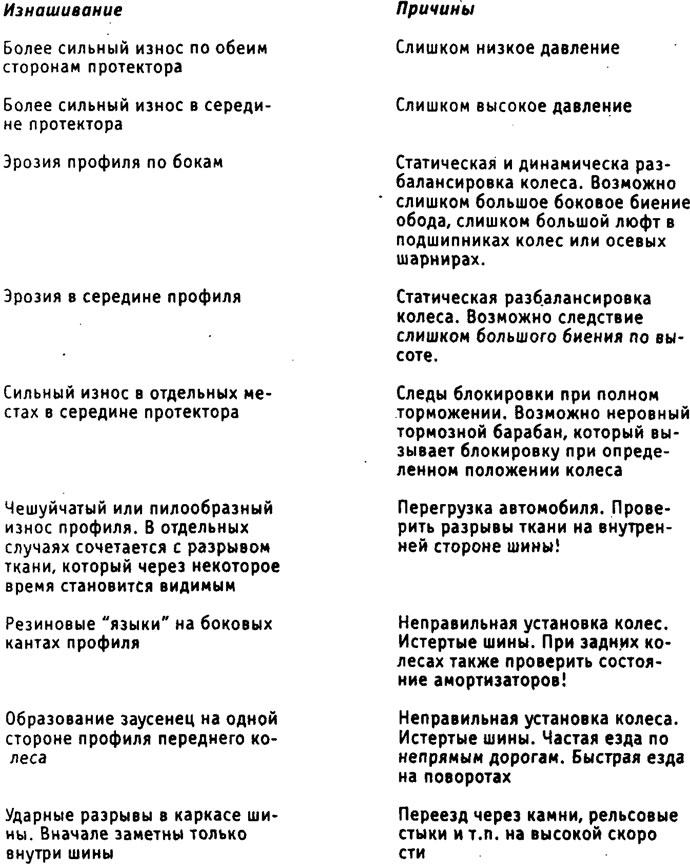
Incorrect wheel installation and imbalance lead to a characteristic wear pattern, which is indicated in the tire fault table.
Anti-skid chains
All models can use only chains with small links, which protrude on the tread and the inside of the tire by at least 15 mm. It is better to use chains recommended by Volkswagen. The speed with chains should not exceed 40 km / h. On roads without snow and ice, they must be removed, because they wear out quickly.
Tire pressure
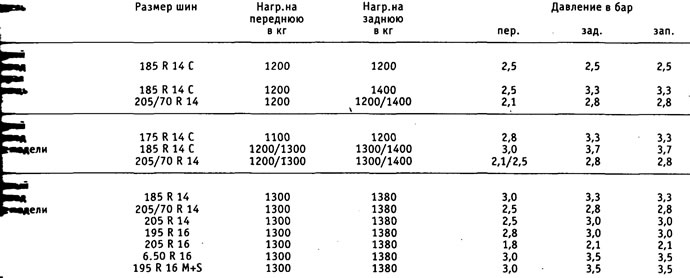
[The original text can be found on the portal vwmanual.ru]
When using winter tires, the pressure should be increased by 0.2 bar.
Attention! Technical development goes further. For older models other pressures or tire combinations may be allowed. The determining criterion is the vehicle documents.
Table of tire faults
Visitor comments