



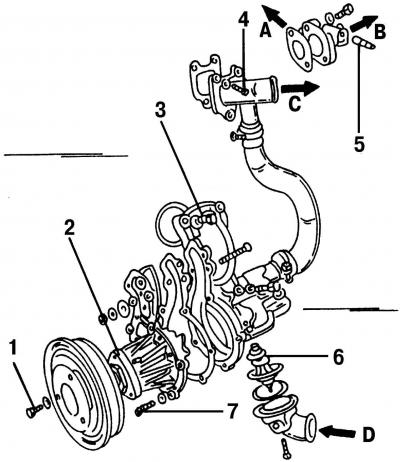
Fig. 468. Coolant pump: 1 - bolt, 20 Nm; 2 - coolant pump; 3 - bolt, 10 Nm; 4 - bolt, 10 Nm; 5 - coolant temperature sensor, 7 Nm; 6 - thermostat; 7 - bolt, 10 Nm; A - attached to the cylinder head; B - to the heat exchanger; C - to the heater radiator; D - from the radiator
The thermostat controls the redistribution of coolant flows in the engine cooling system. The thermostat is located in the water pump housing under the cover, which has a sealing ring (Fig. 468).
Procedure for removing the thermostat (work is carried out on a cold engine):
- drain the coolant from the cooling system;
- disconnect the supply hose;
- remove the thermostat cover;
- remove the thermostat with the sealing ring.
Note: To gain easy access to the thermostat, raise the front of the vehicle and support it on stands.
The thermostat cannot be repaired, so if it is faulty, replace it. A simple check of the thermostat's functionality is carried out as follows:
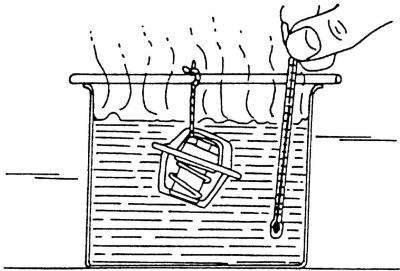
Fig. 192. Checking the thermostat's functionality
- hang the thermostat on a wire and lower it into a container with cold water (Fig. 192);
- hang the thermometer (with a temperature measurement interval of at least 10–120°C) so that it does not touch the bottom of the vessel;
- heat the water.
Check:
- 1) will the thermostat start to open at 85°C;
- 2) at a temperature of 105°C the thermostat should open completely;
- 3) the thermostat pin must extend from the housing by at least 7 mm.
If the thermostat fails this test, it must be replaced.
When installing the thermostat, use a new gasket. Check the hose clamp before reinstalling it on the hose. Fill the cooling system with coolant as described in section 19.1.1.
Visitor comments