



Contents: Special tool required: ↓ Necessary consumables: ↓ Removal brake fluid from the clutch…↓ Attention, perform a safety…↓
Special tool required:
- Open ring wrench for air bleed valve.
- Transparent plastic hose and container for draining brake fluid.
Necessary consumables:
- POLO: 1.1 l of brake fluid specification DOT 4.
- IBIZA: 2.0L of DOT 4 specification brake fluid.
Brake fluid is able to absorb moisture from the air through the pores in the brake hoses and the ventilation hole in the expansion tank cap. Therefore, over time, the boiling point of the brake fluid decreases. Under heavy load on the brakes, vapor locks can form in the brake pipes, which greatly disrupts the operation of the brake system.
Brake fluid should be replaced every 2 years, preferably in the spring. If you drive a lot on mountain roads, you should replace the brake fluid at shorter intervals.
Note: The work procedures for replacing brake fluid are very similar to those for bleeding the brake system. The following description of the procedures only points out the differences, so in any case you should also read the chapter "Bleeding the brake system".
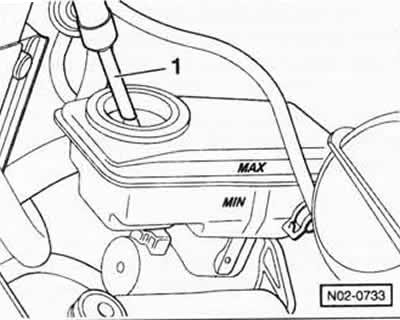
Mark the brake fluid level on the expansion tank with a felt-tip pen. When replacing the brake fluid, ensure that it is at its original level. This will help prevent the expansion tank from overflowing when replacing the brake pads.
Using suction container "1", suck out as much brake fluid as possible from the expansion tank, leaving, however, a layer of liquid approximately 10 mm thick at the bottom of the tank.
Fill the expansion tank with new brake fluid up to the MAX mark.
Remove old brake fluid from all brake calipers one by one by pumping it using the brake pedal. The drained brake fluid must in any case be clean and without air bubbles. Approximately 250 cm³ (¼ liter) of brake fluid must be pumped through each brake caliper.
Note: On an IBIZA, approximately 400 to 500 cm³ of brake fluid must be bled through each brake caliper.
Attention: Do not forget to refill the expansion tank with new brake fluid. It should never be empty, otherwise air will enter the brake system. If the expansion tank is empty, then in this case the air must be removed at a service station, since a special diagnostic device is required to remove air from the ABC hydraulic unit.
After replacing the brake fluid, press the brake pedal and check its free travel. The free travel should not exceed ⅓ of the pedal's full travel.
Removal brake fluid from the clutch hydraulic drive
Since the clutch hydraulic drive also uses brake fluid, the contents of the hydraulic drive also need to be replaced.
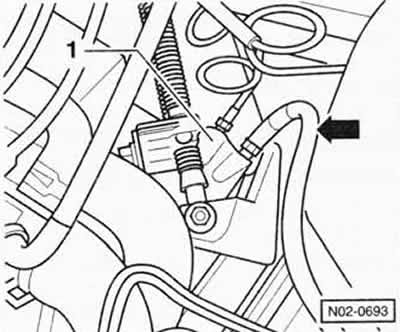
Remove the dust cap from the air bleed valve on the clutch slave cylinder "1". Clean the air bleed valve.
Place a clean transparent "arrow" hose onto the air bleed valve.
The article is posted on this website: VWManual
Insert the other end of the hose into a bottle half filled with brake fluid. Suitable hoses and containers are available at stores that sell car accessories.
Release the bleed valve and have an assistant press the clutch pedal. This may cause approximately 0.1 liter of brake fluid to leak out through the hose.
While holding the pedal down, tighten the air bleed valve.
Remove the air bleed hose and set it aside along with the container.
Release the clutch pedal.
Fill the brake fluid level in the expansion tank to the level marked before replacing the fluid.
Tighten the lid of the expansion tank.
Attention, perform a safety compliance check:
- Are the brake hoses tightly tightened?
- Are the brake hoses in the holders?
- Are the air bleed valves tightened?
- Is there enough fluid in the brake system?
- With the engine running, perform a leak test. To do this, apply a force of 200 to 300 N to the brake pedal for approximately 10 seconds (from 20 to 30 kg). Do not loosen the brake pedal. Check all connections for leaks.
Finally, perform several braking maneuvers on a street with little traffic. In doing so, make at least one hard braking maneuver with the ABS control action engaged (determined by the pulsation of the brake pedal). Earlier ABS control action is evident on soft ground.
Caution: Before doing this, make sure that there is no moving vehicle nearby behind you.
Visitor comments