
English Русский
Български
Беларускі
Український
Српски
Hrvatski
Română
Polski
Slovenský
Magyar
  |  Articles  |  Sitemap  |  Contacts  |    |
Car maintenance Ford Car maintenance Hyundai Car maintenance Chevrolet Car maintenance BMW Car maintenance Audi Car maintenance Opel Car maintenance AvtoVAZ
VWmanual.ru


Main   Passat   Golf   Polo   Touareg   Tiguan   Sharan   Transporter   Others  
Passat B2 (1981-1988) Passat B3 (1988-1993) Passat B4 (1988-1996) Passat B5 (1996-2005) Passat B6 (2005-2010)

Exhaust system catalytic converter (VW Passat B5)

  • Main
  • Passat
  • Passat B5
  • Power unit
  • Exhaust system
  • Exhaust system catalytic converter
            0


Contents: Petrol engines ↓ Diesel engines ↓

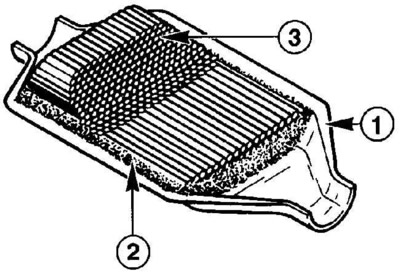
Catalyst


Catalyst

  • 1 - body,
  • 2 - seal,
  • 3 - honeycomb catalyst

Elements entering the catalyst and products leaving the catalyst
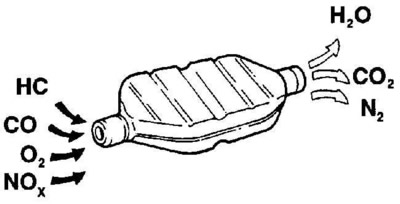


Elements entering the catalyst and products leaving the catalyst


All vehicles are equipped with catalytic converters to reduce the amount of harmful substances emitted into the atmosphere through exhaust gases.

The exhaust gas catalyst has a stainless steel housing to which the inlet and outlet cones with pipes and mounting flanges are welded, as well as heat reflectors holding the ceramic lining. The entire internal volume of the housing is occupied by a ceramic porous monolith, fixed with rings or a stainless steel mesh. The structure of the monolith is a regular filter, but the entire internal and external surface of the pores in contact with gases is covered with a very thin molecular layer of an alloy containing platinum, rhodium and palladium. The porosity of the monolith has a large surface area covered with this alloy of very expensive metals, which mainly determines the high price of catalysts, see Fig. Catalyst.


The catalytic converter causes a reaction that converts potentially hazardous hydrocarbons and carbon monoxide in the exhaust gases into harmless gases and water vapor.

The engine emits into the atmosphere together with the exhaust gases the products of complete combustion (water vapor H 2 O, nitrogen N 2 etc.) and incomplete (carbon monoxide CO, as well as CnHm, nitrogen oxides NOx) combustion of fuel. The total number of components contained in these gases exceeds several hundred, and most of them are harmful to human health.

The exhaust gases, penetrating the porous surface of the monolith, firstly heat it, and secondly, oxidize. CO ₂ is obtained from CO, that is, non-toxic carbon dioxide, CnHm in several stages turns into CO ₂ and H ₂ O, NOx turns into molecular N₂, which is contained in ordinary air, and into water. In short, rather complex chemical reactions occur in the catalyst, due to the high temperature and the presence of a special coating of expensive metals.

The main positive effect of the catalyst is the complete neutralization of three components – CO, CnHm, NOx, – which are more abundant in exhaust gases than other harmful substances. And it is achieved not only due to the presence of platinum, rhodium and palladium. The temperature, maintained within the range of 300–800°C, plays an important role. If it drops to 250°C, chemical reactions of neutralization of CO, CnHm, NOx, despite the presence of metal catalysts, will not occur. And at a temperature of about 900°C, the catalytic film begins to melt and disintegrate.


Petrol engines


On all models with a catalytic converter, the fuel supply system is closed-loop, i.e. based on the signal from the oxygen sensor installed in the exhaust system, the control unit constantly optimizes the composition of the fuel-air mixture. Depending on the oxygen content in the exhaust gases, the oxygen sensor induces a voltage of 0.1 V (high oxygen, lean mixture) up to 0.9 V (low oxygen, rich mixture). Based on this data, the engine control unit changes the opening time of the fuel injectors and changes the fuel ratio in the fuel-air mixture. The metric ratio of the fuel mixture, at which its complete combustion occurs and there are no harmful substances in the exhaust gases, is 14.7 weight parts of air to 1 part of fuel, see Fig. Elements included in the catalyst and products leaving the catalyst.

The catalyst operates effectively at temperatures of +300°C – +800°C.

Diesel engines


In vehicles with diesel engines, exhaust gas cleaning is performed by a non-regulated oxidation catalyst.

The percentage of nitrogen oxides in the exhaust gases of a diesel engine is reduced by installing an exhaust gas re-burning (EGR) system on the vehicle. The EGR valve of the exhaust gas re-burning system is installed in the knee of the exhaust system and is controlled by a vacuum regulator. The EGR valve on a warmed-up engine directs part of the exhaust gases into the combustion chambers of the engine, which reduces the temperature and at the same time reduces the percentage of nitrogen oxides in the exhaust gases.

This article is available at russian, bulgarian, belarusian, ukrainian, serbian, croatian, romanian, polish, slovak, hungarian
The text has been checked: Tarasov Ivan

Share information:

Previous articles
Exhaust system device
Next articles
Operation of vehicles with a catalytic converter
Turbocharger for diesel engines
Replacing the muffler
Oxygen sensor


Similar articles from other manuals for VW cars:
Exhaust system Golf 1 (1974-1984, petrol)
Exhaust gas system Polo 3 (1995-2003)
Catalytic converter Touareg 1 (2002-2006)
Catalyst and exhaust system attachments Tiguan 1 (2007-2015)
Removal and installation of the exhaust system Sharan 1 (1995-2000)
Exhaust system of the 2.1L engine with catalytic converter Transporter T3 (1979-1992)
Exhaust system components with catalytic converter for BJB and… Caddy 3 (2003-2010)
Link to this page in different formats


Visitor comments


No comments yet


How much will 27 + 32 =


Passat B6 
  • General information
  • User manual
  • Maintenance
  • Petrol engine 1.6L
  • Engine repair
  • Cooling and lubrication system
  • Fuel injection system
  • Petrol engine 2.0L
  • Engine repair
  • Lubrication system
  • Cooling system
  • Fuel and exhaust systems
  • Diesel engine 2.0L
  • Engine repair
  • Cooling and lubrication system
  • Fuel and exhaust systems
  • Transmission
  • Clutch
  • Mechanical gearbox
  • Automatic gearbox
  • Drive shafts
  • Chassis
  • Wheels and tires
  • Car suspension
  • Steering
  • Brake system
  • Body
  • Exterior (external elements)
  • Electrical equipment
  • Power devices
  • Lighting and appliances
  • Electrical circuits
Passat B5 
  • General information
  • User manual
  • Weekly checks
  • Maintenance
  • Power unit
  • Engine repair
  • Cooling system
  • Fuel system (petrol)
  • Fuel system (diesel)
  • Engine management
  • Exhaust system
  • Transmission
  • Clutch
  • Car gearbox
  • Drive shafts
  • Chassis
  • Car suspension
  • Wheels and tires
  • Steering
  • Brake system
  • Body
  • Exterior (external elements)
  • Interior (internal elements)
  • Doors and covers
  • Ventilation and heating
  • Electrical equipment
  • Power devices
  • Lighting and appliances
  • Electrical circuits
Passat B4 
  • General information
  • User manual
  • Maintenance
  • Technical data
  • 8-valve engine
  • Engine repair
  • Cooling and lubrication system
  • Supply system
  • Ignition system
  • Fuel injection «Mono-Jetronic»
  • Control system «Mono-Motronic»
  • Control system «Digifant»
  • Control system «Simos»
  • 16-valve engine
  • Engine repair
  • Cooling and lubrication system
  • Fuel injection «K-Jetronic»
  • Control system «KE-Motronic»
  • Control system «Digifant»
  • Diesel engine
  • Engine repair
  • Cooling and lubrication system
  • Power and control system
  • Turbocharging system
  • Digital control system
  • Transmission
  • Clutch
  • Manual gearbox
  • Hydromechanical gearbox
  • Front wheel drive
  • Chassis
  • Car suspension
  • Steering
  • Brake system
  • Body
  • Body elements
  • Electrical equipment
  • Power devices
  • Lighting and appliances
  • Electrical circuits
Passat B3 
  • General information
  • User manual
  • Driving Tips
  • Maintenance instructions
  • Technical data
  • Power unit
  • Engine repair
  • Ignition system
  • Lubrication system
  • Cooling system
  • Supply system
  • Petrol injection system
  • Diesel engine
  • Exhaust system
  • Transmission
  • Clutch
  • Car gearbox
  • Chassis
  • Suspension
  • Steering
  • Brake system
  • Wheels and tires
  • Body
  • Exterior
  • Interior
  • Heating system
  • Electrical equipment
  • Power devices
  • Lighting system
  • Equipment and devices
  • Wiper system
  • Electrical circuits
Passat B2 
  • General information
  • Introduction to instructions
  • User manual
  • Power unit
  • Engines 4-cylinder FZ
  • Engines 4-cylinder
  • Engines 5-cylinder
  • Transmission
  • Clutch
  • Four-speed gearbox
  • Five-speed gearbox
  • Hydromechanical gearbox
  • Front wheel drive
  • Chassis
  • Front suspension
  • Rear suspension
  • Steering
  • Brake system
  • Body
  • Body elements
  • Electrical equipment
  • Equipment and devices
  • Electrical circuits
VWmanual.ru © 2016-2026 | Mobile version | News and articles | Sitemap: EN BG BY UA RS HR RO PL SK HU | Write message | Site search
Passat B2 • Passat B3 • Passat B4 • Passat B5 • Passat B6 • Golf 1, diesel • Golf 1, petrol • Golf 2, petrol • Golf 2 • Golf 3 • Golf 4 • Golf 5 • Polo 3 • Polo 4 • Touareg 1 • Tiguan 1 • Sharan 1 • Transporter T3 • Transporter T4 • LT 28 • LT 2D • Beetle • Caddy 3 •
Our website uses cookies to ensure functionality and convenience.