
English Русский
Български
Беларускі
Український
Српски
Hrvatski
Română
Polski
Slovenský
Magyar
  |  Articles  |  Sitemap  |  Contacts  |    |
Car maintenance Ford Car maintenance Hyundai Car maintenance Chevrolet Car maintenance BMW Car maintenance Audi Car maintenance Opel Car maintenance AvtoVAZ
VWmanual.ru


Main   Passat   Golf   Polo   Touareg   Tiguan   Sharan   Transporter   Others  
LT 28 (1975-1991) LT 2D (1996-2003) Beetle (1960-1986) Caddy 3 (2003-2010)

Maintenance and adjustment (VW Lt 28)

  • Main
  • Volkswagen
  • LT 28
  • Chassis
  • Brake system
  • Maintenance and adjustment
            0


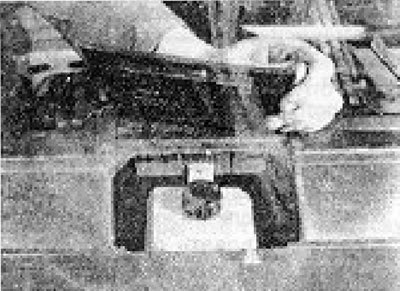
1. At regular intervals specified in "Maintenance schedule", check the brake fluid level in the master cylinder reservoir, which is located under the hinged cover in the center of the dashboard (see photo 2.1).

Photo 2.1. Brake fluid reservoir.

Photo 2.1. Brake fluid reservoir.


Replenishing brake fluid will be required infrequently, and only in small quantities to compensate for its normal consumption during operation of the friction surfaces. As the friction surfaces wear, the pistons move out a little further to ensure effective operation of the braking system.

2. A rapid drop in the brake fluid level and the need to frequently top it up indicates that there is a leak in the system that should be immediately detected and fixed.

3. Also, at regular intervals, check the degree of wear of the brake linings and pads of the discs and drums (see sections 3 and 7).

4. Periodically check the condition of the hydraulic pipes and flexible hoses as described in Section 11.
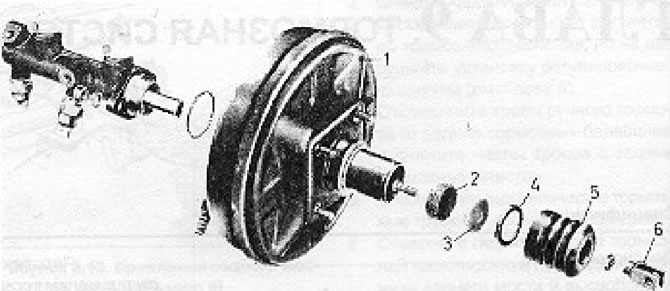
Figure 9.1. Brake booster air filter parts: 1 - Brake booster; 2 - Filter element; 3 - Damper…

Figure 9.1. Brake booster air filter parts: 1 - Brake booster; 2 - Filter element; 3 - Damper muffler; 4 - Fastening ring; 5 - Dust cover; 6 - Support fork.


5. The small air filter in the brake booster must be replaced with a new one regularly. The easiest way to do this is to pull back the dust boots on the lever, remove the retaining ring, and then cut the damper ring off the outer end of the lever and remove it.

6. Remove the air filter in the same way.

7. Cut out the new components and install them, but make sure that. that the slots do not align when the filter and damper ring are already in place.

8. If you want to replace components without cutting them, then you should disconnect the lever from the pin. When reassembling, please refer to (Section 13) for details on adjustment.

9. The brake fluid must be replaced every three years, since by this time it will have absorbed a significant amount of moisture from the atmosphere and will contribute to the formation of corrosion on the internal surfaces.

10. The absorption of moisture by the brake fluid also leads to a decrease in its boiling point, and then, during prolonged or very sharp braking, this can lead to the formation of steam bubbles in the hydraulic system, which, in turn, will reduce braking efficiency or even lead to complete brake failure.

11. To replace the brake fluid, simply bleed the brake system, constantly adding new brake fluid to the master cylinder reservoir. The volume of drained fluid must correspond to certain values, given below in the Table. If it corresponds to the specified values, you can be sure that the brake fluid will be completely replaced with new one.


12. Remember that hydraulic fluid is an excellent paint solvent. If it spills on the body, wash it off immediately with plenty of cold water. It should also be taken into account that it is extremely poisonous, so do not allow it to enter your mouth and wash it off immediately if it comes into contact with your skin.

Bleed nipple for brake pad/cylinderVolume of drained liquid (cubic cm)
Rear right500
Rear left500
Right front (lower)500
Right front (upper)100
Left front (lower)500
Left front (upper)100
Pressure regulating valve100

This article is available at russian, bulgarian, belarusian, ukrainian, serbian, croatian, romanian, polish, slovak, hungarian
The text has been checked: Kolesnikov Artem

Share information:

Previous articles
Description of the braking system
Brake system specifications
Next articles
Brake disc pads — inspection and replacement
Hydraulic Components — disassembly (general information)
Brake shoe (caliper) — removal, overhaul and installation
Disk — check and replace
Rear brake pads — inspection and replacement
Rear wheel cylinder — removal, overhaul and installation


Similar articles from other manuals for VW cars:
Front seat adjustment Passat B3 (1988-1993)
Data for maintenance purposes Golf 1 (1974-1984, petrol)
Seat adjustment Polo 3 (1995-2003)
Removal, installation and adjustment of the multi-function… Touareg 1 (2002-2006)
Maintenance indicator Tiguan 1 (2007-2015)
Repair and maintenance work Sharan 1 (1995-2000)
Windscreen Washer Jets — Removal, Installation and Adjustment Transporter T4 (1990-2003)
Link to this page in different formats


Visitor comments


No comments yet


How much will 31 + 50 =


Caddy 3 
  • General information
  • User manual
  • Daily care
  • Maintenance
  • Petrol engines 1.4 l
  • Engine repair
  • Cooling and lubrication system
  • Power and exhaust system
  • Petrol engines 1.6 l
  • Engine repair
  • Cooling and lubrication system
  • Power and exhaust system
  • Diesel engines
  • Engine repair
  • Cooling and lubrication system
  • Power and exhaust system
  • Transmission
  • Mechanical gearbox 0AH
  • Mechanical gearbox 0A4
  • Drive shafts
  • Chassis
  • Car suspension
  • Steering
  • Brake system
  • Body and wiring diagrams
  • Interior and exterior
  • Electrical circuits
Beetle 
  • General information
  • Maintenance
  • Power unit
  • Engine repair
  • Cooling and lubrication system
  • Supply system
  • Exhaust system
  • Transmission
  • Clutch
  • Car gearbox
  • Chassis
  • Front suspension
  • Rear suspension
  • Steering
  • Brake system
  • Wheels and tires
  • Body
  • Exterior
  • Electrical equipment
  • Equipment and devices
  • Power devices
  • Electrical circuits
LT 2D 
  • General information
  • User manual
  • Maintenance
  • Power unit
  • Petrol engines 2.3 l
  • Diesel engines 2.5 l
  • Diesel engines 2.8 l
  • Injection system (diesel 2.8 l)
  • Transmission
  • Clutch
  • Manual gearbox
  • Differential
  • Chassis
  • Car suspension
  • Steering system
  • Brake system
  • Body
  • Body elements
  • Heating system
  • Electrical equipment
  • Equipment and devices
  • Electrical circuits
LT 28 
  • General information
  • Maintenance
  • Power unit
  • Petrol engines 2.0L
  • Petrol engines 2.4L
  • Diesel engines
  • Cooling and heating
  • Fuel and exhaust system
  • Ignition system
  • Transmission
  • Clutch
  • Car gearbox
  • Cardan shaft
  • Rear axle
  • Chassis
  • Brake system
  • Car suspension
  • Steering system
  • Body
  • Body elements
  • Doors, locks and windows
  • Electrical equipment
  • Power devices
  • Equipment and devices
  • Electrical circuits
VWmanual.ru © 2016-2026 | Mobile version | News and articles | Sitemap: EN BG BY UA RS HR RO PL SK HU | Write message | Site search
Passat B2 • Passat B3 • Passat B4 • Passat B5 • Passat B6 • Golf 1, diesel • Golf 1, petrol • Golf 2, petrol • Golf 2 • Golf 3 • Golf 4 • Golf 5 • Polo 3 • Polo 4 • Touareg 1 • Tiguan 1 • Sharan 1 • Transporter T3 • Transporter T4 • LT 28 • LT 2D • Beetle • Caddy 3 •
Our website uses cookies to ensure functionality and convenience.