



Safety instructions
If the wiring connections are not strictly followed, there is a risk of burns from battery electrolyte discharge. In addition, injuries or damage may occur due to battery explosion. In addition, the vehicle's electrical system may be damaged.
- Avoid contact of electrolyte with eyes, skin, fabrics and varnished surfaces. Electrolyte is caustic. Wash off acid splashes immediately with plenty of clean water. Call a doctor if necessary.
- Do not allow any sparks or open flames near the battery, as flammable gases may be released from the battery.
- Work with protective glasses.
- Make sure that the jumper cables are not damaged by rotating parts, such as the radiator fan.
The cross-section of the jumper cable for petrol engines with a displacement of up to approximately 2.5 litres must be at least 16 mm² (diameter approximately 5 mm). For diesel engines and petrol engines with a working volume of over approximately 2.5 litres, the cross-section of the wire must be at least 25 mm². The working volumes are specified for a vehicle engine with a discharged battery. The cross-section of the wire is usually indicated on its packaging.
Both batteries must be rated for 12V.
If present, open the cover over the battery.
A discharged battery can freeze at temperatures as low as -10°C. Before connecting the jumper cable, the frozen battery must be thawed.
The discharged battery must be properly connected to the vehicle's electrical system.
If possible, check the electrolyte level in the discharged battery, top up with distilled water if necessary, and tighten the filler caps.
The cars should be placed at a distance that excludes contact with their metal parts. Otherwise, current may flow when the positive pole is connected.
Put both cars on the handbrake. Set the gear selector to neutral, if there is an automatic transmission, set the mode selector lever to position P.
Turn off all electrical consumers, including the car telephone.
During the starting process, the engine of the vehicle supplying the current must be idling. This helps to avoid possible damage to the generator due to voltage peaks during the starting process.
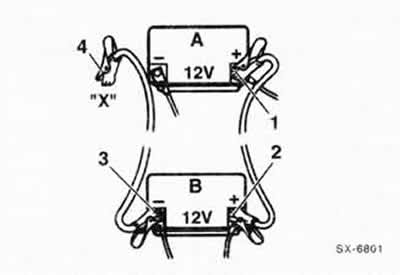
Connect the jumper wires in the following sequence:
1. Connect one end of the -1- red wire to the positive pole (+) of the discharged battery "A".
2. Connect the other end of the red wire "2" to the positive pole (+) of the battery "B" that supplies current.
3. Connect one end of the "3" black wire to the negative pole (-) of the battery that supplies current.
4. Connect the other end of the "4" black wire to the body of the -X-receiving current vehicle.
Caution: Not to the negative (-) terminal of a discharged battery.
The best way to do this is to use a metal part that is firmly screwed to the engine. Under unfavorable circumstances, when connecting a wire to the negative terminal of a discharged battery, it can explode due to sparking and the formation of detonating gas in it.
Caution: The terminals of the connected jumper cables must not come into contact with each other, and the positive terminals must not come into contact with the body parts (body or frame) - risk of short circuit!.
Current receiving vehicle engine (with a discharged battery)start and let it idle. When starting, do not keep the starter running continuously for more than 10 seconds, as the terminals and wires heat up due to the high starting current. The "cooling pause" between two consecutive starting attempts should be at least ½ minute.
After starting, do not disconnect the jumper cables for approximately three minutes.
To avoid voltage spikes when disconnecting the jumper cables, turn on the heating system fan and rear window defroster in a car with a discharged battery. Do not turn on the headlights. When the voltage spikes, the incandescent bulbs burn out.
After starting, disconnect the starting wires in the reverse order to what they were connected: first, the end of the black wire "4" (-) at the current-receiving vehicle, then at the current-sending vehicle. Disconnect the red wire "2" first at the current-sending vehicle, then at the current-receiving vehicle.
Visitor comments