



- The nominal voltage of both batteries must be 12 V. The capacity of the battery used to start the engine must not be significantly lower than the capacity of the discharged battery.
- For this purpose, it is necessary to use auxiliary starting wires with a sufficiently large cross-section. When using wires, follow the manufacturer's instructions.
- We recommend purchasing auxiliary jumper cables from the original accessory kit or from the battery manufacturer's brand stores. Use only jumper cables with insulated terminals.
Caution! A discharged battery can freeze at temperatures just a few degrees below zero. Before attempting to jump start a vehicle using a battery in another vehicle, it is important to allow the frozen battery to warm up slowly, otherwise it may explode when started.
The engine of the vehicle whose battery is used to start your vehicle must be running when you start it.
Connecting both vehicles using jumper cables is absolutely necessary in the following sequence:
- connect one end of the positive (+) cable, usually marked red, to the positive (+) terminal of the dead battery:
- connect the other end of the positive (+) wire to the positive (+) terminal of the auxiliary battery located in the other vehicle that will be used for starting;
- connect one end of the negative (-) wire, usually marked in black, to the negative (-) pole terminal of the auxiliary battery located in the vehicle, which will be used to start the engine;
- connect the other end of the negative (-) wire firmly to the part of the vehicle being started that is firmly connected to the engine block, or connect it directly to the engine block itself.
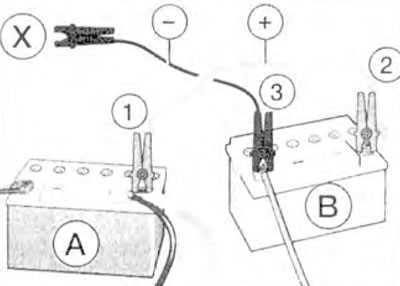
A - discharged battery; B - a storage battery that will be used to start the car engine.
Caution! Do not connect the cable to the negative (-) terminal of a discharged battery. The strong spark produced when starting the engine can ignite the oxyhydrogen gas emitted from the battery.
Attention!
- Under no circumstances should mutual contact be allowed between the bare, uninsulated parts of the auxiliary starting lead terminals to facilitate starting. In addition, the jumper cable connected to the positive (+) terminal of the battery must not be allowed to come into contact with live parts (metal) vehicle parts, which may result in a risk of short circuit.
- Position jumper wires so that they are not damaged by moving parts in the engine compartment of both vehicles.
- Do not lean over batteries as this may expose you to the risk of injury from corrosive electrolyte.
- Eliminate the possibility of the presence of ignition sources (open fire, lit cigarette, etc.).
- Start the car engine.
If the engine does not start within approximately 10 seconds, then stop trying to start the engine and try again after approximately 30 seconds.
- After starting the engine, disconnect the auxiliary jumper wires in reverse order.
[The information is posted on this website vwmanual.ru]
Visitor comments