



Caution: Before installing additional electrical appliances, check whether the existing alternator can handle the increased load. If necessary, install a higher capacity alternator.
Checking the generator charging voltage
If the battery is not charged sufficiently, the generator charging voltage must be checked.
Connect a voltmeter between the positive and negative terminals of the battery.
Start the engine. When starting the engine, the voltage with a fully charged battery should not fall below 8 volts (at an electrolyte temperature of approximately +20°C).
Increase the engine crankshaft speed to 3000 1/min. The voltage should be between 13.0 and 14.5 volts. This is proof that the generator and the voltage regulator are working properly. To recharge the battery while driving, the generator voltage (on-board voltage) must be higher than the battery voltage.
Check the stability of the voltage regulation. To do this, turn on the high beam and repeat the measurement at an engine crankshaft speed of 3000 1/min. The measured voltage value should not exceed the value obtained before by more than 0.4 volts.
If the measured voltage values are outside the permissible limits, the generator and voltage regulator must be checked at a service station.
Safety instructions
When working with the electrical system, be sure to disconnect the ground (-) wire from the battery.
Caution: This erases the contents of electronic memory devices, such as engine fault codes. Before disconnecting the battery, you should also read the instructions in the chapter "Removal and installation the battery".
I Do not disconnect the battery or voltage regulator while the engine is running.
Do not remove the generator while the battery is connected.
Before carrying out electric welding work, the battery must be disconnected.
Removal
With the ignition off, disconnect the ground (-) cable from the battery.
Attention: Follow the instructions given in the chapter "Removal and installation the battery".
Note: Depending on the model, generators of different designs are installed.
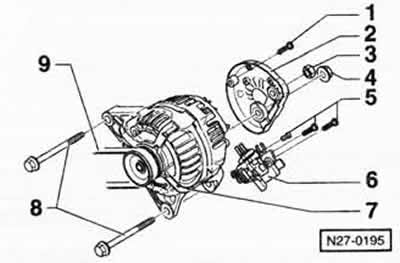
Generator 1
1 - Phillips head screws
2 - protective cover
3 - nut
4 - nut
5 - Phillips head screws
6 - voltage regulator
7 - generator
8 - bolts, 25 Nm
9 - poly V-belt
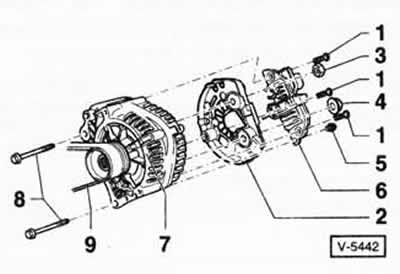
Generator 2
1 - Phillips head screws
2 - protective cover
3 - nut
4 - nut
5 - Phillips head screws
6 - voltage regulator
7 - generator
8 - bolts, 25 Nm
9 - poly V-belt
Loosen and remove the poly V-belt "9".
The information is posted on this website VWMANUAL
Disconnect the plug connector from the rear of the generator and unscrew the fastening of the thin wire (D+).
Remove the protective cap and unscrew the thick wire fastening (B+).
Unscrew bolts "8" and remove the generator from the crankcase.
Installation
Place the generator and bolt it to the bracket.
Check the poly V-belt for wear and replace if necessary.
Place the poly V-belt on the pulleys and tighten it.
Tighten the wire (B+) to the generator. The tightening torque is 15 Nm.
Caution: If the wire fastening is tightened to a torque other than the specified value, the following malfunctions may occur:
- The battery is not fully charged.
- Complete failure of car electrics/electronics.
- Risk of fire due to sparking.
- Damage due to overvoltage of electronic components/control units.
Screw the thin wire (D+) to the generator.
With the ignition off, connect the ground (-) wire to the battery.
Attention: Follow the instructions given in the chapter "Removal and installation the battery".
After installation, start the engine and check the running of the poly V-belt.
Visitor comments