



Motor oil specification
Use motor oils according to VW standards 500 00 or 501 01. Only in exceptional cases: all-season oils according to API-SF or SG classification.
The lubrication system is shown in the figure 2.55.
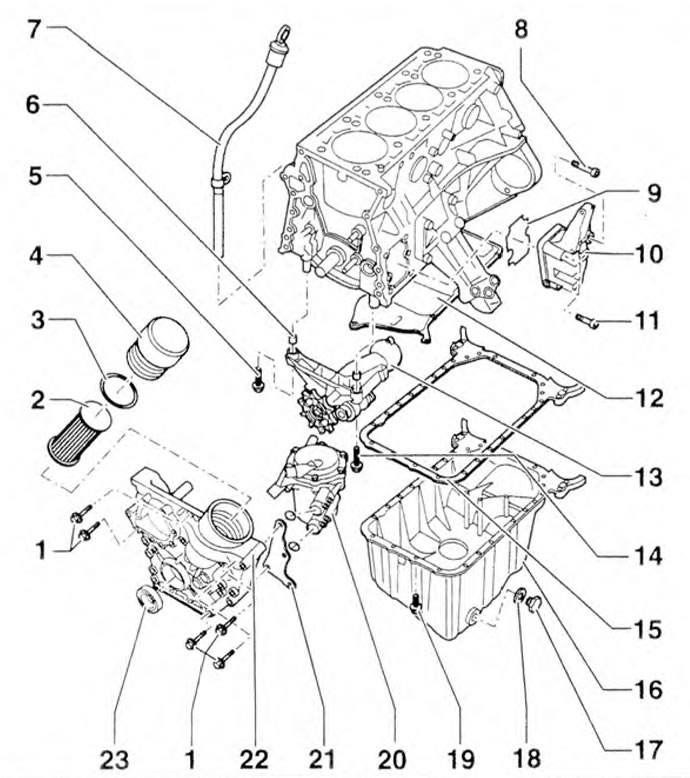
Figure 2.55. Lubrication system: 1, 5, 8, 11, 14, 19 - Bolts; 2 - Oil filter: 3 - Seal; 4 - Lid; 6 - Adjusting sleeve; 7 - Guide pipe; 9 - Gasket. 10 - Bracket; 12 - Defoamer; 13 - Oil pump; 15 - Gasket: 16 - Pallet; 17 - Drain plug; 18, 23 - Oil seals; 20 - Oil radiator; 21 - Mounting angle; 22 - Lower cover of the distribution mechanism.
Checking the oil pressure and oil pressure switch
1. Unscrew the oil pressure switch (white insulation) and screw it into the tester along with the 1342/5 adapter. Screw the tester and the 1342/4 adapter into the cylinder block in place of the switch. Connect the brown tester lead to the negative battery terminal, and the VAG 1527 LED test light with auxiliary wires from the VAG 1594 to the positive battery terminal, and connect the oil pressure switch to (figure 2.56). The LED should light up.
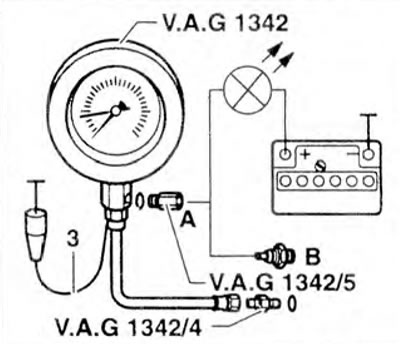
Figure 2.56. Screw the tester together with adapter 1342/4 into the cylinder block in place of the switch. Connect the brown tester lead to the negative battery terminal, the VAG 1527 LED test light with auxiliary wires from the VAG 1594 to the positive battery terminal, and connect oil pressure switch B.
2. Start the engine and let it idle. When the engine warms up to operating temperature, the oil pressure should be at least 0.3 bar
3. Turn off the engine.
4. Start the engine and slowly increase the engine speed. At 0.20 bar the LED should go out, otherwise replace the oil pressure switch.
5. Continue to increase the speed. At 3000 rpm and an oil temperature of 90°, the oil pressure should be at least 3.0 bar.
Visitor comments