



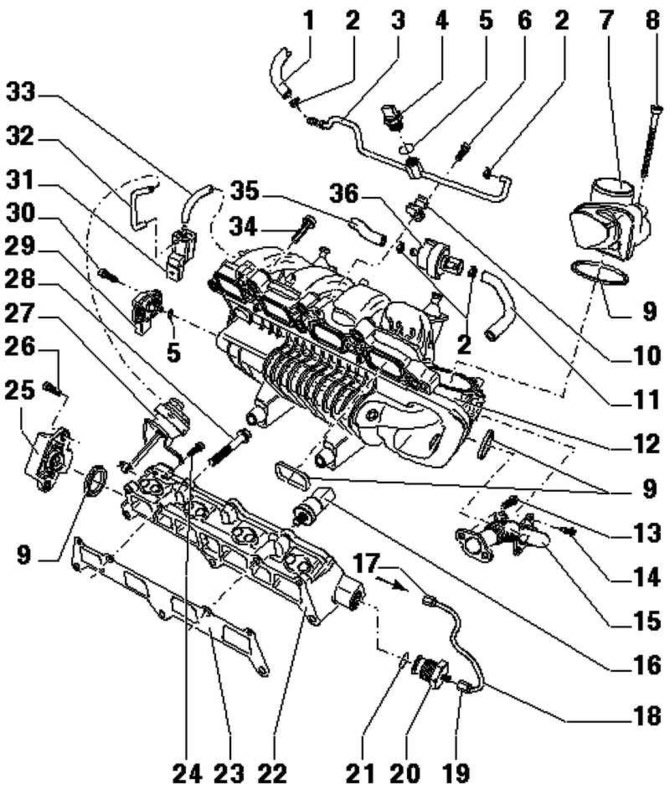
Fig. 2.66. Intake manifold components: 1 – fuel supply line; 2 – clamp; 3 – fuel line; 4 – fuel pressure sensor for low pressure 18 Nm; 5 – O-ring round section; 6 – bolt 10 Nm; 7 – Throttle control module; 8 – bolt 10 Nm; 9 – sealing ring; 10 – mounting clip; 11 – from the electromagnetic valve 1 of the activated carbon absorber; 12 – intake manifold; 13 – bolt 8 Nm; 14 – bolt 5 Nm; 15 – connecting tube; 16 – fuel pressure sensor 20 Nm; 17 – union nut, 30 Nm; 18 – high pressure line; 19 – union nut, 25 Nm; 20 – bolt 20 Nm; 21 – O-ring round section; 22 – lower part of the intake manifold; 23 – gasket; 24 – bolt 10 Nm; 25 – intake manifold flap potentiometer; 26 – bolt 1.5 Nm; 27 – vacuum drive; 28 – bolt 20 Nm; 29 – intake manifold pressure sensor; 30 – bolt 5 Nm; 31 – intake manifold flap valve; 32 – vacuum hose; 33 – vacuum hose; 34 – bolt 20 Nm; 35 – to the electromagnetic valve 1 of the activated carbon absorber; 36 – electromagnetic valve 1 of the activated carbon absorber
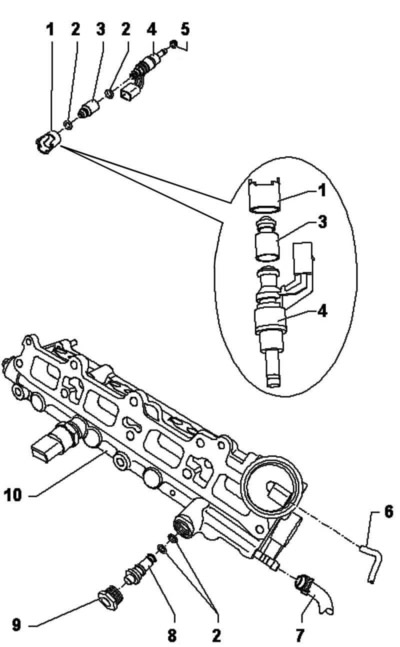
Fig. 2.67. Fuel rail with injectors: 1 – mounting bracket; 2 – O-ring round section; 3 – spacer sleeve; 4 – cylinder 4 injector; 5 – sealing ring; 6 – vacuum hose; 7 – return line; 8 – pressure reducing valve; 9 – bolt 20 Nm; 10 – lower part of the intake manifold
Checking the operation of the intake manifold flap
After installing the new lower intake manifold, remove the vacuum actuator retaining bracket.
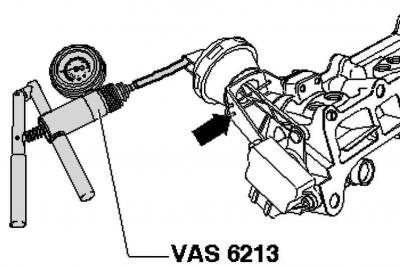
Fig. 2.68. Connecting a hand vacuum pump
Connect the hand vacuum pump as follows (Fig. 2.68).
Create a vacuum and check the serviceability of the actuator of the vacuum drive by the lever arm.
Note: With the intake manifold removed, the operation of the intake manifold flap can be checked at the same time.
Visitor comments