



The designations of the most important elements are given in Table 26.
Table 26. Designations of the most important elements
| Designation | Element |
| A | Battery |
| IN | Starter |
| WITH | Alternator |
| D | I Ignition switch |
| E | Manually operated switch |
| F | Mechanical switch (limit switch, etc.) |
| G | Sensor, control device |
| n | Sound signal, dual tone signal |
| J | Relay, control unit |
| K, L, M, W, X | Control lamps, illuminating lamps |
| N | Electrovalves, resistors, switching units |
| ABOUT | Distributor |
| R, Q | Spark plug connector, spark plugs |
| R | Radio |
| S | Fuses |
| t | Detachable connections |
| V | Electric motors |
To accurately identify an element on a diagram, the element's serial number is placed after the letter of its symbol. Relays and electronic control units are usually depicted with a gray fill.
The number in the black square indicates the relay field number in the mounting block; the contact designation is located directly next to the relay shown.
Example: If a contact on the diagram is marked with the number 17/87, this means that 17 is the terminal number in the mounting block, and 87 is the designation of the relay or control unit terminal.
The most important terminals are labeled as follows:
Terminal 30. Battery voltage is constantly applied to this terminal. The wire is always red or red with colored stripes.
Terminal 31 is connected to ground. Ground wires are usually brown.
Voltage is supplied to terminal 15 via the ignition switch. Voltage is present when the ignition is on. The wires are usually green or green with colored stripes.
Terminal X is also energized when the ignition is on, but the voltage is disconnected when the starter is turned on, thereby ensuring full transfer of battery current to the starter. All more or less powerful current consumers are connected to this terminal. As a result, in particular, when the ignition is turned off, the high beam is automatically switched to the sidelights.
Conventional designations of elements and their connections on electrical circuits are given in Figure 469.
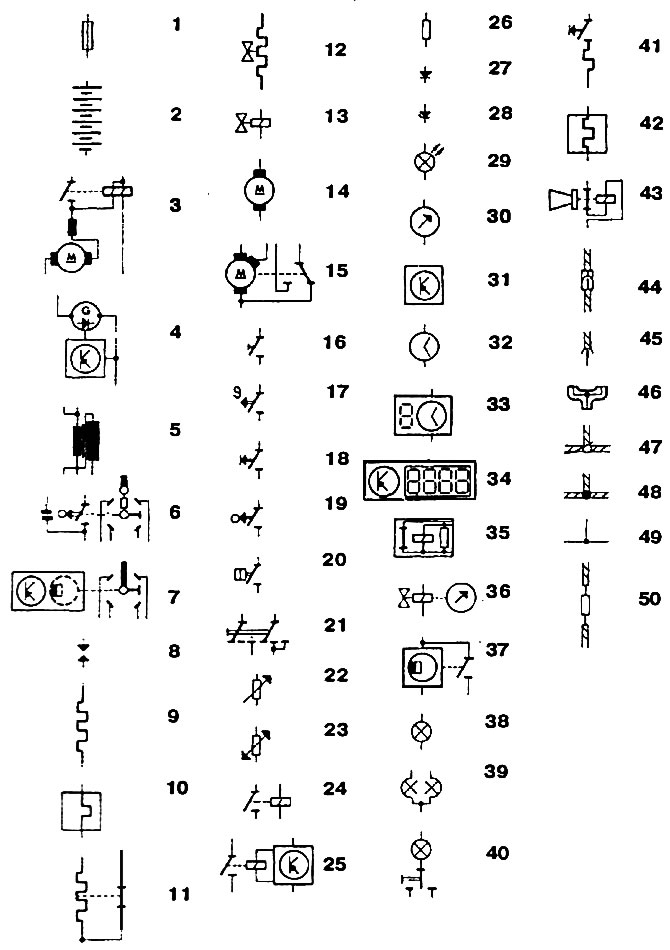
Figure 469. Conventional symbols of elements and their connections in electrical circuits: 1 - fuse; 2 - battery; 3 - starter; 4 - alternating current generator; 5 - ignition coil; 6 - ignition distributor (mechanical); 7 - ignition distributor (electronic); 8 - tip and spark plug; 9 - starting spark plug, heating element; 10 - automatic carburetor starting device; 11 - time thermal relay; 12 - pressure regulator, additional air damper; 113 - electromagnetic valve; 14 - Electric motor; 115 - Windscreen wiper motor (2-speed); 16 - switch (manual); 17 - thermal switch; 18 - keys; 19 - mechanical switch ("limit switch"); 20 - pressure switch; 21 - Multi-pole switch (manual); | 22 - variable resistor; 23 - Oil and coolant temperature sensor; 24 - relay; 25 - electronically controlled relay; 26 - resistor; 27 - diode; 28 - Zener diode; 29 - LED; 30 - arrow pointer; 31 - electronic | control unit; 32 - hands watch; 33 - digital clock; 34 - multifunctional cylinder; 35 - buzzer; 36 - fuel reserve sensor; 37 - tachometer sensor; 38 - incandescent lamp; 39 - incandescent lamp (double-stranded); 40 - Interior lighting lamp; 41 - cigarette lighter; 42 - rear window heater; 43 - sound signal; 44 - Multi-pin plug connection: 45 - Multi-pin plug connection; 46 - branch connection; 47 - detachable wire connection; 48 - permanent connection of wires; 49 - connection of wires inside the element; 50 - wire with resistance
Visitor comments