



Warning! When handling antifreeze, remember that it is poisonous and causes severe poisoning.
Company «Volkswagen» fills the cooling system of its engines with concentrated G11 antifreeze, and since 1999, instead of G11, it uses G12 antifreeze, which can be identified by the color that has turned red instead of green.
Attention! G11 and G12 antifreezes should never be mixed, as they are incompatible.
Company «Ford» fills the cooling system of its engines with antifreeze «Motorcraft Super Plus 4».
Antifreeze must be in the cooling system all year round. If you have to dilute antifreeze with water, then the following proportions must be observed:
- freezing limit down to -25°C:
- with one heat exchanger - 3.6 liters of antifreeze per 5.4 liters of water;
- with two heat exchangers - 4.5 liters of antifreeze per 4.5 liters of water;
- with two heat exchangers and an additional heater - 4.6 liters of antifreeze per 6.8 liters of water;
- freezing limit down to -35°C:
- with one heat exchanger - 4.3 liters of antifreeze per 6.5 liters of water;
- with two heat exchangers - 5.4 liters of antifreeze per 5.4 liters of water;
- with two heat exchangers and an additional heater - 5.7 liters of antifreeze per 5.7 liters of water.
The mixture should be prepared in a watering can or other similar vessel for water and poured into the cooling system already prepared. Often, antifreeze is first poured into the cooling system, and then water is added, but the mixture does not form immediately, since it must first be run several times through the cooling system by a water pump.
Attention! When diluting antifreeze with water, it is unacceptable to use sea or hard water and alkali to soften the water.
Note. In the cooling systems of both engines (2.0L and VR6) pour in the same amount of coolant.
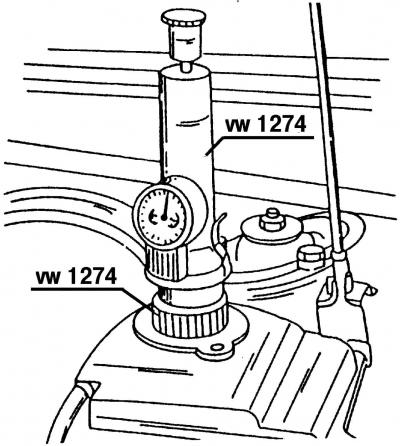
Pic. 185. Checking the tightness of the cooling system using a pressure pump VW1274
Checking the tightness of the cooling system should be carried out using a pressure pump VW1274 (pic. 185).
Install the pressure pump VW1274 on the expansion tank (pic. 185), bring the pressure to 1.0 atmospheres and check that it is maintained for at least 2 minutes. If this does not happen, then there is a coolant leak in the cooling system. In this case, check the following:
- are the hoses of the radiator, engine and heater tight;
- the condition of the hoses by squeezing them with your hand. If the hoses are not elastic, but hard and cracked, they should be replaced;
- density of landings of hoses on branch pipes;
- tightening the hose clamps.
Visitor comments