



Coolant replacement is not included in the annual maintenance schedule.
If the cylinder head, cylinder head gasket, radiator, heat exchanger or engine were replaced during repairs, the coolant must be replaced in any case. This is necessary because corrosion additives settle on new light-alloy parts during the running-in period and thus provide a durable anti-corrosion layer.
Old coolant does not contain enough anti-corrosion additives to form a sufficient protective layer on new parts.
Warning! Drained coolant is not suitable for reuse. Coolant is poisonous.
Drain
1. Set the heating to "warm" - warm, to do this, move the regulator in the cabin all the way to the right.
2. Place the machine on supports.
3. Remove the lower engine compartment splash guard.
4. Open the expansion tank cap.
Caution! When the engine is hot, cover the cap with a thick layer of rag before opening it to avoid burns from hot coolant or steam. Open the cap only when the coolant temperature is below 90°C.
The original text can be found at (VWmanual.ru)
5. Place a clean container under the engine or radiator.
4-cylinder engine
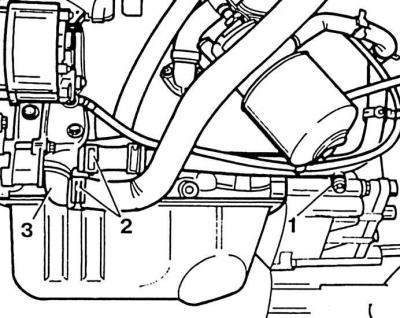
6. Unscrew the threaded plug (1) and remove the coolant hoses (2).
7. Unscrew the flange (3) of the coolant thermostat.
5-cylinder diesel engine
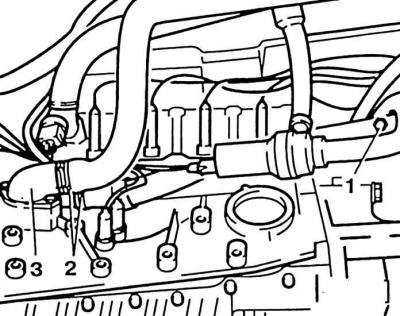
8. Drain the coolant through the threaded plug (1) on the connecting pipe between the expansion tank and the coolant thermostat housing. Then remove the thermostat (2 - coolant hose, 3 - coolant thermostat flange).
9. Drain the coolant completely.
Filling
1. Tighten the drain plug. Install the coolant hoses and secure with clamps. Install the thermostat. Screw on the thermostat flange.
2. Install the lower engine compartment splash guard.
3. Remove the car from the supports.
4. Gradually fill the coolant up to the "MAX" mark on the expansion tank.
Caution! If there is a bleed screw on the upper heating hose, unscrew it. Fill with coolant until it appears from the bleed hole. Tighten the screw. If necessary, add coolant again (up to the "MAX" mark).
5. Close the expansion tank.
6. Let the engine run until the fan comes on.
7. Turn off the engine.
8. Check the coolant level, if necessary top up slightly above the "MAX" mark. At the engine operating temperature, the coolant level should be slightly above the "MAX" mark, on a cold engine, between the "MAX" and "MIN" marks.
Visitor comments