



Work execution procedure
Open the fuel tank filler cap.
Insert the suction hose (fig. 2.311) insert the VAS 5190 fuel extraction device approximately 170-180 cm into the fuel tank filler neck and extract the fuel.
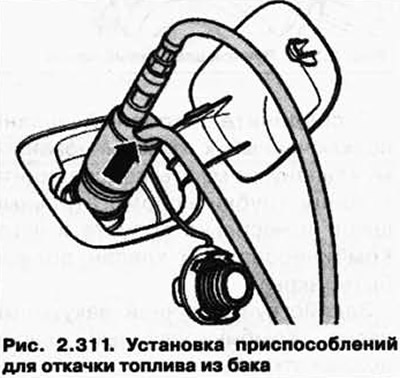
NOTE: If fuel stops being pumped out, the fuel tank is empty enough that the sensor flange can be safely opened. The tank can be removed with the remaining fuel.
If work on fuel pumps and sensors is required, perform the following operations:
Cut the carpet from points A to points B in the pre-cut area (fig. 2.309).
The original information is posted on the resource: VWManual
Unscrew nuts 1 securing the cover. If necessary, unscrew the armrest support 2 or support bracket.
Place a rag under the connection pipe for the fuel supply line and the fuel line of the additional heater and disconnect the hose.
NOTE: To do this, press the button on the coupling.
Disconnect the fuel pump and fuel level sensor connector.
Unscrew the retaining ring using the T10202 key from the sensor flange (fig. 2.312).
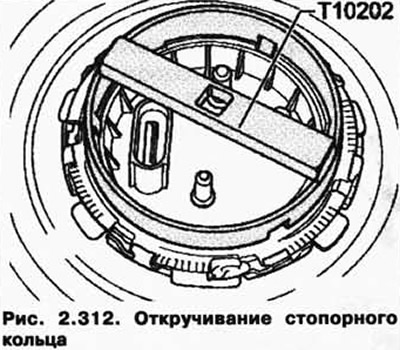
Carefully lift the sensor flange.
Insert the suction hose of the VAS 5190 fuel suction device as far as possible into the right and left sides of the fuel tank and suction out the fuel.
When working on the left side of the tank, follow the instructions above.
When disconnecting the ventilation tubes, the buttons of the hose couplings may not be pressed. In this case, use the installation tool T10118 (fig. 2.313).
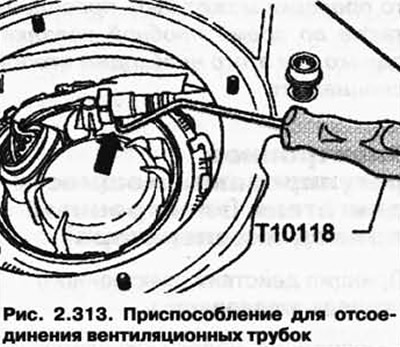
During further work on the internal parts of the fuel tank, the sensor flanges can remain removed.
If it was only necessary to drain the fuel from the tank, the sensor flanges should be reinstalled.
Before installation, check the flange sealing rings for tightness.
NOTE: If the O-rings are swollen due to fuel exposure, they should be replaced.
Install the sensor flanges with the fixing plate in the direction of travel (fig. 2.314).
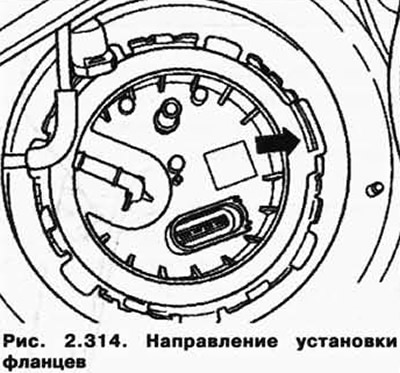
Tighten the retaining rings on the right and left using the T10202 wrench to a torque of 145 Nm.
Visitor comments