



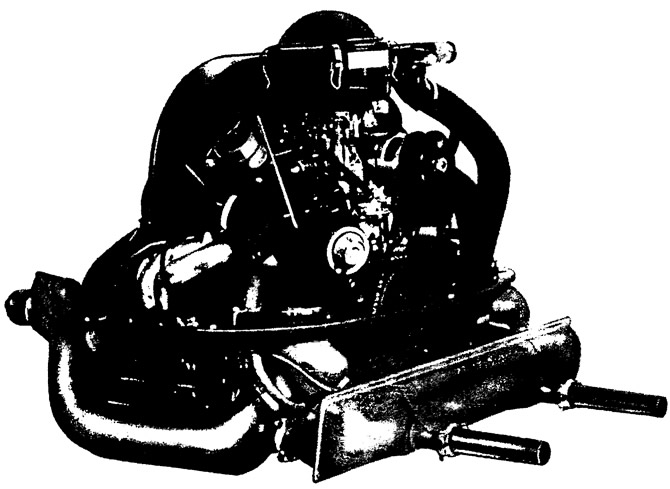
The engine crankcase consists of two parts that are connected to each other with bolts in the plane of the crankshaft and camshaft.
The engine cylinders have the same shape and, if necessary, the cylinders can be replaced separately, complete with piston. Each pair of cylinders has a common head made of aluminum alloy. Each cylinder has two valves, located vertically in the head. They can be replaced after removing the cylinder head. The left and right cylinder heads are completely symmetrical.
Since in opposed engines the cylinders are located on different sides, they are counted starting from the right side as you move backwards. If in doubt, look for the cylinder numbers on the engine cover near the spark plug holes.
The crankshaft is steel, forged, mounted on three main bearings. The fourth bearing (smaller diameter) installed on the rear end of the shaft between the camshaft drive pulley and the V-belt pulley.
The camshaft is mounted in the crankcase under the crankshaft and rotates in three split steel bearings. It is driven by a pair of helical gears. To transmit movement from the cam to the valves, 8 pushers with rods and 8 rocker arms are used.
The lubrication system consists of a camshaft-driven gear pump with a pressure relief valve, an oil cooler and an oil pressure sensor.
A centrifugal fan, the impeller of which is mounted on the generator shaft, is used to cool the engine. The air entering the engine through the cooling channels is conducted in two streams (left and right) around the ribs of the cylinders and then comes out. At the bottom, under the 1st and 2nd cylinders in the air flow, there is a thermostat. It regulates the air supply to the cylinders depending on its temperature. This ensures rapid warm-up of a cold engine.
The original can be viewed on the portal (www.VWManual.ru)
Visitor comments