
English Русский
Български
Беларускі
Український
Српски
Hrvatski
Română
Polski
Slovenský
Magyar
  |  Articles  |  Sitemap  |  Contacts  |    |
Car maintenance Ford Car maintenance Hyundai Car maintenance Chevrolet Car maintenance BMW Car maintenance Audi Car maintenance Opel Car maintenance AvtoVAZ
VWmanual.ru


Main   Passat   Golf   Polo   Touareg   Tiguan   Sharan   Transporter   Others  
Polo 3 (1995-2003) Polo 4 (2001-2009)

Turbocharger for PD-TDI engine with a displacement of 1.4/1.9 l (VW Polo 4)

  • Main
  • Polo
  • Polo 4
  • Power unit
  • Exhaust system
  • Turbocharger for PD-TDI engine with a displacement of 1.4/1.9 l
            0


The turbocharger has two wheels installed on one shaft, a turbine wheel and a compressor wheel, which are located in housings separated from each other. Exhaust gases are used to drive the turbine wheel. They accelerate the turbocharger rotor to a rotation speed of 3,000,001/min. Since the wheels have a common rotor, the compressor wheel rotates at the same angular velocity and pumps fresh air into the engine cylinders. The turbocharger bearings are lubricated by the engine lubrication system.

Thanks to the high filling factor, a power increase of up to 100% can be achieved in existing engines. The power increase depends, among other things, on the boost pressure, which for passenger car engines is usually between 0.4 and 0.8 bar (for comparison, tire pressure is approximately 1.8 bar). The boost pressure is constantly monitored by a sensor and regulated by the control unit. This ensures that the maximum boost pressure cannot be exceeded.

In addition to the engine power, the use of a turbocharger also increases the torque, which is desirable above all from the point of view of smooth engine operation. The prerequisite for this is, first of all, the rotation of the turbocharger rotor at a sufficient frequency, which guarantees the necessary filling of the cylinders with a fresh charge.
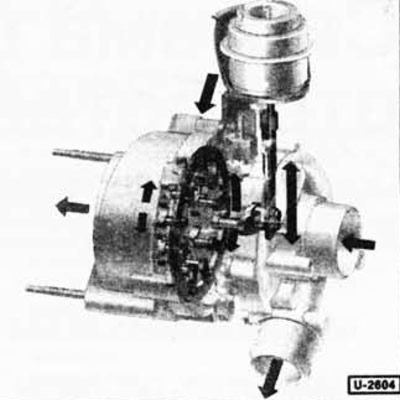
In addition to the engine power, the use of a turbocharger also increases the torque, which is…


In this regard, the engines of POLO/SEAT cars use a turbocharger with variable position of the gas turbine guide vanes (VTG turbocharger - variable turbine geometry). The stepless regulation of the position of the turbine guide vanes is carried out by commands from the engine control unit via an electromagnetic valve and a vacuum membrane mechanism. As a result, at all crankshaft speeds, optimal boost pressure is created, which allows for higher torque and increased power, especially at low speeds.


To improve cylinder filling, a charge air cooler is located between the turbocharger and the engine intake manifold, which cools the air pre-compressed in the turbocharger. Thanks to this, the power output increases, since when the compressed air is cooled, its density and, accordingly, the proportion of oxygen in it increases.

Compared to a petrol engine, a diesel engine does not require a reduction in compression ratio due to the use of turbocharging, so that even at low crankshaft speeds the combustion energy of the injected fuel is fully utilized.

The turbocharger is an extremely precisely manufactured unit. As a rule, if a defect occurs, the turbocharger is replaced as an assembly.

This article is available at russian, bulgarian, belarusian, ukrainian, serbian, croatian, romanian, polish, slovak, hungarian
The text has been checked: Semenova Anna

Share information:

Previous articles
Operation of the catalytic converter
Preventing Damage to the Catalytic Converter
Exhaust gas system
Next articles
Exhaust system design (1.2L petrol engine)
Exhaust system design (1.4L petrol engine)
Exhaust system design (1.4L diesel engine)
Exhaust system design (1.9L diesel engine)
Removal and installation of the exhaust system
Replacing the pre/post muffler


Similar articles from other manuals for VW cars:
Removal and installation a turbocharger on an AFN engine Passat B4 (1988-1996)
Engine adjustment data Golf 1 (1974-1984, petrol)
Car engine number Touareg 1 (2002-2006)
Car engine number Tiguan 1 (2007-2015)
Diesel engine fuel system and turbocharger Sharan 1 (1995-2000)
Starting the engine from another source Transporter T4 (1990-2003)
Visual inspection of parts in the engine compartment and on the… Caddy 3 (2003-2010)
Link to this page in different formats


Visitor comments


No comments yet


How much will 26 + 46 =


Polo 4 
  • General information
  • User manual
  • Maintenance
  • Power unit
  • Engine repair
  • Cooling and lubrication system
  • Control system
  • Injection system (diesel)
  • Supply system
  • Exhaust system
  • Chassis
  • Front suspension
  • Rear suspension
  • Steering
  • Wheels and tires
  • Brake system
  • Body
  • Interior
  • Exterior
  • Electrical equipment
  • Equipment and devices
  • Wiper system
  • Lighting system
  • Electrical circuits
Polo 3 
  • General information
  • User manual
  • Maintenance
  • Power unit
  • Petrol engines 1.4 and 1.6
  • Petrol engines 1.4 (V16)
  • Petrol engines 1.6 and 1.8
  • Diesel engines 1.7 and 1.9
  • Diesel engines 1.9 D and TD
  • Transmission
  • Mechanical gearbox 085
  • Mechanical gearbox 020/02K
  • Chassis
  • Front suspension
  • Rear suspension
  • Steering
  • Brake system
  • Body
  • Exterior
  • Interior
  • Electrical equipment
  • Equipment and instruments (until 2000)
  • Equipment and instruments (after 2000)
  • Electrical circuits
  • Wiring diagrams (petrol)
  • Wiring diagrams (diesel)
VWmanual.ru © 2016-2026 | Mobile version | News and articles | Sitemap: EN BG BY UA RS HR RO PL SK HU | Write message | Site search
Passat B2 • Passat B3 • Passat B4 • Passat B5 • Passat B6 • Golf 1, diesel • Golf 1, petrol • Golf 2, petrol • Golf 2 • Golf 3 • Golf 4 • Golf 5 • Polo 3 • Polo 4 • Touareg 1 • Tiguan 1 • Sharan 1 • Transporter T3 • Transporter T4 • LT 28 • LT 2D • Beetle • Caddy 3 •
Our website uses cookies to ensure functionality and convenience.