



Contents: Fault detection and error indication ↓ Replacing the instrument cluster ↓ Removal and installation the…↓ Description of the rear side of the…↓
The following elements are built into the instrument cluster:
- Control unit in instrument cluster "J285"
- Immobilizer control unit "J362"
- Speedometer
- Tachometer
- Fuel gauge
- Coolant temperature gauge
- Multifunctional display
- Control lamps
For sound support of some optical indicators, the instrument cluster has a buzzer controlled by the control unit. All control lamps are equipped with LEDs. Repair of the instrument cluster is not provided. If necessary, the instrument cluster is replaced entirely. The diagnostic interface of the data bus "J533" (Gateway) is designed as a separate control unit and is not, as in various other cars, an integral part of the instrument cluster.
Fault detection and error indication
The instrument cluster is equipped with a self-diagnosis function, which facilitates the search for errors. To search for faults, use the tester -VAS 5051 A- in the "Guided Fault Finding" mode.
Replacing the instrument cluster
The Tiguan is equipped with a fourth-generation immobilizer with online connection and download. The most important part of the fourth-generation immobilizer is the central database, which contains all theft-related data of the individual control units. It is not possible to adapt the control units involved in the immobilizer without an online connection to this database. PIN queries for immobilizer components by fax or by temporary connection are not possible. All components involved in the immobilizer must be taught in online mode. All (including those ordered later) the vehicle keys are pre-coded at the factory and can only be taught to the vehicle in question. Subsequent key orders are made upon presentation of the corresponding chassis number. Adaptation of components from other brands of the Group to Volkswagen vehicles is no longer possible.
Removal and installation the instrument cluster
Instructions: If a new instrument cluster is installed in the vehicle, the instrument cluster control unit must be configured for the various trim levels and equipment options for a given country. In order to adapt the integrated immobilizer to the engine control unit, the data from the engine control unit must be stored in the replacement instrument cluster. In addition, after installing the new instrument cluster, all vehicle keys must be adapted. Before replacing the instrument cluster, the sequence of actions "Replacing the instrument cluster" must be performed in each case to read the data stored in the control unit.
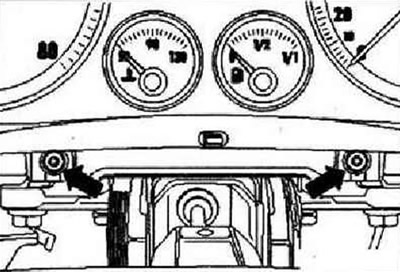
Turn off the ignition and all electrical consumers, remove the ignition key.
Instructions: No need to remove the steering wheel.
Pull the steering wheel forward completely and lock it in the lowest position. Remove the steering column slot adjustment. Unscrew the instrument cluster "arrow" mounting screws.
Instructions: There is no need to disconnect the connectors when removing the instrument cluster. The connector is permanently attached to the vehicle and is automatically disconnected when the instrument cluster is removed.
Remove the instrument cluster from the dashboard.
Installation is carried out in reverse order.
Description of the rear side of the instrument cluster
Instructions: It is prohibited to disassemble the instrument cluster. If necessary, the instrument cluster is replaced entirely.
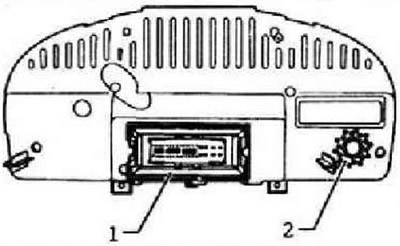
- 1 - Connector, 36-pin
- 2 - Warning buzzer
Visitor comments