



Attention! The power system is under high pressure. Before disconnecting any of the fuel system components, it is recommended to place rags around the connection. Then relieve the pressure by carefully loosening the connection.
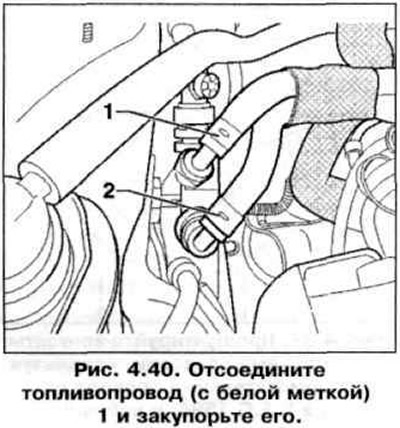
1. Disconnect the fuel line (with white mark) 1 and plug it (pic. 4.40).
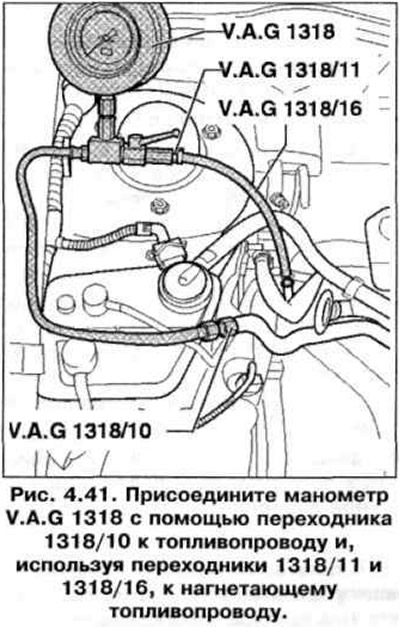
2. Connect the pressure gauge VAG 1318 using adapter 1318/10 to the fuel line and, using adapters 1318/11 and 1318/16, to the injection fuel line (pic. 4.41). Open gauge valve (the handle must point in the direction of the arrow).
3. Start the engine and let the engine idle.
4. Measure fuel pressure. It should be about 2.5 bar.
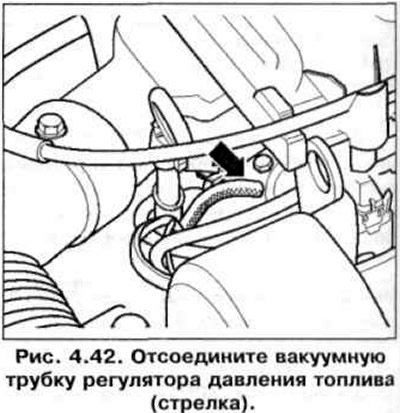
5. Disconnect the fuel pressure regulator vacuum tube (arrow) (pic. 4.42). The fuel pressure should increase to approximately 3.0 bar. Switch off the ignition.
6. If the specified value is not reached, check the supply of the fuel pump.
7. If the specified value is reached, check for leaks and the holding pressure by observing the pressure drop on the pressure gauge. After 10 minutes it should be at least 2 bar.
8. If the holding pressure is less than 2 bar: start the engine and let the engine idle.
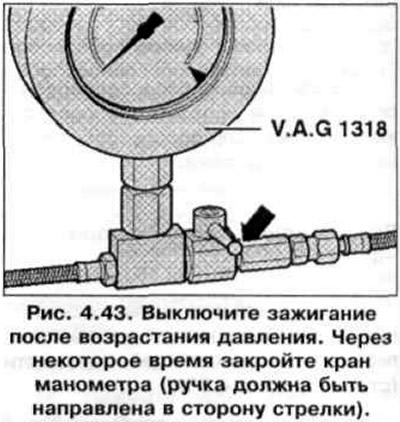
9. Turn off the ignition after the pressure rises. After a while, close the valve of the manometer (the handle must point in the direction of the arrow) (pic. 4.43).
10. Watch the pressure drop on the pressure gauge.
11. If the pressure does not drop: check the fuel pump bypass valve.
12. If the pressure drops again: open the pressure gauge valve (handle in the direction of the arrow) (pic. 4.41).
13. Start the engine and leave the engine to idle.
14. Turn off the ignition after the pressure rises. After a while, close the fuel drain line (with blue marking) 2.
15. If the pressure does not drop: replace the fuel pressure regulator.
16. If pressure drops again: Check fuel line connections, o-rings on high pressure fuel line and injectors. Check the fuel gauge for fuel leaks.
Visitor comments