
English Русский
Български
Беларускі
Український
Српски
Hrvatski
Română
Polski
Slovenský
Magyar
  |  Articles  |  Sitemap  |  Contacts  |    |
Car maintenance Ford Car maintenance Hyundai Car maintenance Chevrolet Car maintenance BMW Car maintenance Audi Car maintenance Opel Car maintenance AvtoVAZ
VWmanual.ru


Main   Passat   Golf   Polo   Touareg   Tiguan   Sharan   Transporter   Others  
Polo 3 (1995-2003) Polo 4 (2001-2009)

Checking the coolant temperature sensor (VW Polo 3)

  • Main
  • Polo
  • Polo 3
  • Power unit
  • Diesel engines 1.9 D and TD
  • Checking the coolant temperature sensor
            0


1. Connect the VAG 1551 tester and dial "01" to select the "Address word" function of the engine control unit. The engine should be idling. The display should show the following information:

1. Connect the VAG 1551 tester and dial «01» to select the «Address word» function of the engine…

2. Press "08" to select the "Read measured value block" function and confirm by pressing the "Q" button. The display should show the following information:

2. Press «08» to select the «Read measured value block» function and confirm by pressing the «Q»…

3. Press "007" to select the "Display Group 7" function and press "Q". The display should show the following information:

3. Press «007» to select the «Display Group 7» function and press «Q». The display should show the…

Check the coolant temperature value in field 4. It should increase smoothly without delay. In the fault condition, the fuel temperature is displayed.


4 Click "→".

5. Press "06" to select the "Complete Output" function and confirm by pressing the "Q" button.

6. Turn off the ignition.

7. If there is no real display in field 4 or the fuel temperature is displayed, check the coolant temperature sensor and wires:

(The original text can be found on the portal: VWManual)
  • press "→";
  • press "06" to select the "Complete Output" function and confirm by pressing the "Q" button;
  • turn off the ignition;
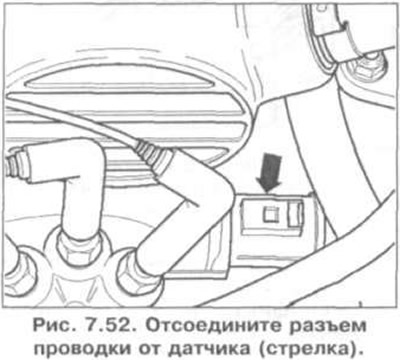
  • disconnect the wiring connector from the sensor (arrow) (Fig. 7.52).
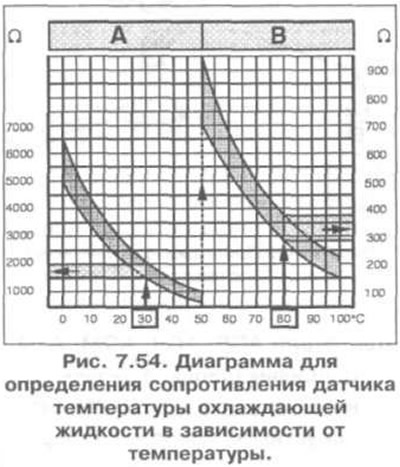
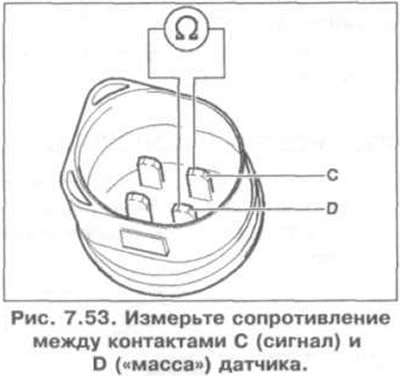
  • measure the resistance between contacts C (signal) and D (ground) of the sensor (Fig. 7.53). The specified value is shown in Fig. 7.54. Area A shows the resistance in the temperature range of 0-50°C, area B - the resistance in the temperature range of 50-100°C. For example, a temperature of 30°C corresponds to a resistance of 1500-2000 Ohm; temperature 80°C corresponds to resistance 275-375 Ohm.
measure the resistance between contacts C (signal) and D (ground) of the sensor (Fig. 7.53). The…


measure the resistance between contacts C (signal) and D (ground) of the sensor (Fig. 7.53). The…


measure the resistance between contacts C (signal) and D (ground) of the sensor (Fig. 7.53). The…


8. If the specified value is not achieved, replace the sensor.


9. If the specified value is reached:
  • connect the VAG 1598/22 tester to the engine control unit wiring harness (fig. 7.38);
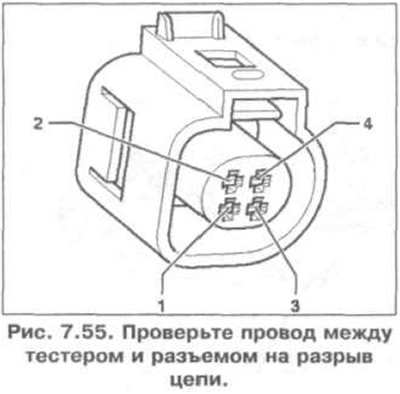
  • check the wire between the tester and the socket for open circuit: contact 1 and socket 70, contact 3 and socket 54 (Fig. 7.55). Specified value: 1.5 Ohm;
  • additionally check the wires for open circuit. Specification resistance: ∞ Ohm.
additionally check the wires for open circuit. Specification resistance: ∞ Ohm.


10. If no fault is found in the wires, replace the engine control unit.

This article is available at russian, bulgarian, belarusian, ukrainian, serbian, croatian, romanian, polish, slovak, hungarian
The text has been checked: Kolesnikov Artem

Share information:

Previous articles
Checking the crankshaft speed sensor
Checking the injectors
Removal and installation of fuel injection pump
Reading a block of measured values
Clearing fault memory
Querying fault memory
Next articles
Checking the fuel temperature sensor
Checking the injector needle displacement sensor
Checking the air flow meter
Checking the intake manifold switching valve
Error codes


Similar articles from other manuals for VW cars:
Checking the coolant temperature sensor Passat B4 (1988-1996)
Coolant temperature sensor Golf 1 (1974-1984, petrol)
Checking the oil pressure sensor (petrol engine) Touareg 1 (2002-2006)
Removal and installation coolant temperature sensor G62 Tiguan 1 (2007-2015)
Checking the temperature sensor of a remote thermometer Sharan 1 (1995-2000)
Removal and installation the coolant temperature gauge sensor Transporter T3 (1979-1992)
Checking the coolant temperature sensor LT 2D (1996-2003)
Link to this page in different formats


Visitor comments


No comments yet


How much will 50 + 47 =


Polo 4 
  • General information
  • User manual
  • Maintenance
  • Power unit
  • Engine repair
  • Cooling and lubrication system
  • Control system
  • Injection system (diesel)
  • Supply system
  • Exhaust system
  • Chassis
  • Front suspension
  • Rear suspension
  • Steering
  • Wheels and tires
  • Brake system
  • Body
  • Interior
  • Exterior
  • Electrical equipment
  • Equipment and devices
  • Wiper system
  • Lighting system
  • Electrical circuits
Polo 3 
  • General information
  • User manual
  • Maintenance
  • Power unit
  • Petrol engines 1.4 and 1.6
  • Petrol engines 1.4 (V16)
  • Petrol engines 1.6 and 1.8
  • Diesel engines 1.7 and 1.9
  • Diesel engines 1.9 D and TD
  • Transmission
  • Mechanical gearbox 085
  • Mechanical gearbox 020/02K
  • Chassis
  • Front suspension
  • Rear suspension
  • Steering
  • Brake system
  • Body
  • Exterior
  • Interior
  • Electrical equipment
  • Equipment and instruments (until 2000)
  • Equipment and instruments (after 2000)
  • Electrical circuits
  • Wiring diagrams (petrol)
  • Wiring diagrams (diesel)
VWmanual.ru © 2016-2026 | Mobile version | News and articles | Sitemap: EN BG BY UA RS HR RO PL SK HU | Write message | Site search
Passat B2 • Passat B3 • Passat B4 • Passat B5 • Passat B6 • Golf 1, diesel • Golf 1, petrol • Golf 2, petrol • Golf 2 • Golf 3 • Golf 4 • Golf 5 • Polo 3 • Polo 4 • Touareg 1 • Tiguan 1 • Sharan 1 • Transporter T3 • Transporter T4 • LT 28 • LT 2D • Beetle • Caddy 3 •
Our website uses cookies to ensure functionality and convenience.