



Contents: Ground clearance adjustment ↓ System action when selecting a lower…↓ Changing ground clearance (body…↓ Emergency shutdown ↓ "LOCK" key ↓ Characteristics of individual levels ↓
Ground clearance adjustment
NOTE: Adjusting the ground clearance allows you to change the height of the vehicle chassis above the road surface.
There are four chassis position levels to choose from (Lade, StraKen, Offroad and X'tra). With all four different chassis settings, a constant vehicle height above the road is maintained on both axles, depending on the load. Height sensors provide the system with data on the distance between the axles and the body. If the actual distance differs from the nominal value, the air pressure in the suspension is changed via the compressor and receiver, and the nominal distance between the axles and the body for the given level is achieved.
If the vehicle lift mode for changing a wheel was activated using the "LOCK" button and a hose was attached to the tire inflation nipple, the ride height adjustment is automatically switched off.
When driving on normal roads, we recommend setting the ground clearance for normal roads to StraKen.
When one of the settings is selected, the corresponding indicator on the instrument panel starts to flash. The indicator stops flashing only when the specified ground clearance is reached.
The system's action when selecting a higher ground clearance.
When the driver selects a higher ground clearance, the system checks whether there is enough compressed air in the receiver to increase the ground clearance. If there is enough compressed air in the receiver, the process of increasing the ground clearance takes a few seconds.
If the receiver is empty by the time a new ground clearance is selected, compressed air begins to flow into the air suspension from the compressor. This process can last several minutes, and the duration depends on the operating temperature of the compressor. The fact is that the compressor automatically switches off when the maximum permissible operating temperature is reached and switches on again after it cools down.
The process of changing the ground clearance will not start when the message "Supplying air to the receiver" appears on the display. In this case, wait a few minutes and set the desired ground clearance again.
System action when selecting a lower ground clearance
The transition to a lower ground clearance is achieved by releasing compressed air from the air springs.
The only exception is the transition to the Lade level. The lowering of the body to this level occurs only when the compressed air supply in the receiver is sufficient for the subsequent transition to the StraKen level.
If the compressed air supply is insufficient, the body does not lower. The message "Air supply to receiver" appears on the instrument panel display.
Changing ground clearance (body level)
- 1. LOCK button. Limits the speed to 70 km/h with the ground clearance set to Off road. Activates the vehicle lifting mode for changing a wheel.
- 2. Lade - constant and the smallest ground clearance.
- 3. StraKen - automatically adjustable ground clearance depending on the driving speed.
- 4. Offroad - ground clearance automatically adjusted depending on the speed.
- 5. X'tra - constant and the highest ground clearance.
- 6. Rotary switch for selecting ground clearance.
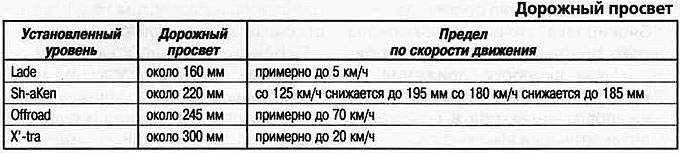
To set the required ground clearance, it is necessary that the rotary switch 6 (fig. 1.116) was not recessed. If it is recessed, press it. Set the desired ground clearance and recess the switch.
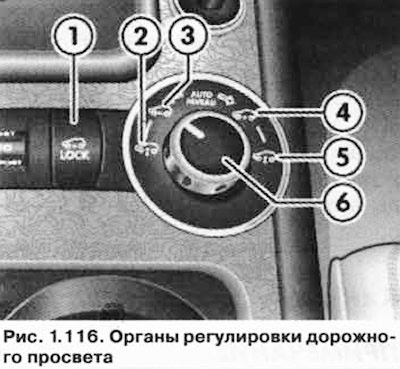
Switch 6 is fixed in positions 3 and 4. If you want to set level 2 or 5, turn the switch to the appropriate position. In these positions, the switch is not fixed. The selection of levels 2 or 5 can be canceled by turning the switch again to the same position.
The selected level is indicated by the illumination of the corresponding icon near the switch.
In principle, the selection of any level is only possible when the speed limit for the selected ground clearance is not exceeded at the time of its setting (e.g. 5 km/h when selecting the Lade level or 20 km/h when selecting the X'tra level). Otherwise, the specified setting of the ground clearance will not occur. The display shows the message: "Not possible".
Emergency shutdown
All processes of changing the ground clearance are immediately stopped and the previous level is restored if the ignition is turned off during the change of ground clearance.
The values given are valid for a stationary vehicle. When moving, these values may vary due to level adjustment.
NOTE: While the indicator on the instrument cluster is flashing, the selected level has not yet been reached.
"LOCK" key
NOTE: The "LOCK" button has two functions: speed limitation and activation of the "tire change vehicle lift mode".
To limit the speed, select the Offroad level.
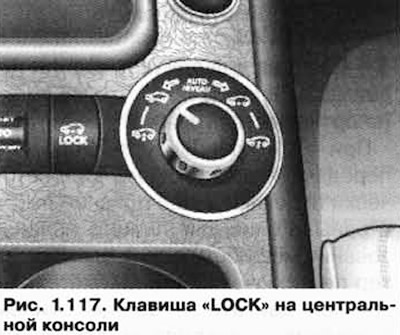
Press the "LOCK" button and the maximum speed will be limited to approximately 70 km/h (fig. 1.117).
To activate the vehicle lift mode for changing a tire, stop the vehicle and apply the parking brake.
Note: The speed limit value for a reduced transmission "LOW" stage is set by the engine management system. The maximum speed limit is between approximately 70 and 100 km/h.
Leave the ignition on.
Press and hold the "LOCK" button for more than five seconds. The "lift the car to change the wheel" mode is now activated.
Turn off the ignition.
The speed limit is implemented by the engine control unit and is only effective when the vehicle is moving at the Offroad level.
(The article is published on this resource: «www.VWMANUAL.ru»)
After pressing the "LOCK" button, the backlight turns on, the maximum speed is limited to 70 km/h. If the car was moving faster up to this point, the speed limit is not introduced, and the message "Impossible" appears in the instrument panel.
The speed limit is only applied when the vehicle is moving slower than 70 km/h with the Offroad level set and the "LOCK" button is pressed again. When this function is activated in off-road conditions, it is not possible to lower the vehicle body level. The speed limit is removed by pressing the button again. In this case, the pressure on the gas pedal should be further reduced.
Speed limits help improve safety on bad roads. Before driving on normal roads with normal surfaces, turn off the speed limiter.
At speeds above 65 km/h, the driver is reminded of the previously set speed limit by a warning signal and a corresponding pictogram on the display. If the speed limit function fails at speeds above approximately 78 km/h, a red pictogram appears on the display and three warning signals sound. At speeds above approximately 80 km/h, the StraKen level is automatically set and the speed limit is lifted.
To activate the vehicle lift mode for changing a wheel, stop the vehicle and leave the ignition on. Then press the "LOCK" button and hold it down for more than five seconds. The active state of the vehicle lift mode for changing a wheel is indicated by a message on the display and a flashing indicator lamp in the "LOCK" button. After activating this mode, you can turn off the ignition.
When the vehicle is lifted to change a tire, the ride height adjustment is not possible to avoid changing the vehicle level when the jack is installed under the vehicle. The previously set level is retained. After changing a tire with the ignition on, press and hold the "LOCK" button again for more than five seconds or drive at a speed higher than 5 km/h to reactivate the ride height adjustment.
Characteristics of individual levels
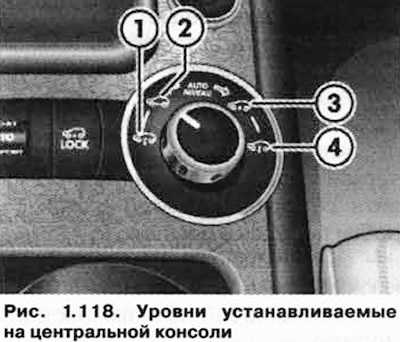
Level Lade 1 (fig. 1.118) can only be set when the vehicle is stationary or moving at walking speed. It is recommended to set this level when loading and unloading the luggage compartment. At the Lade level, the lowest ground clearance is achieved and maintained unchanged. If you switch off the ignition before the Lade level is reached, the previous level is set.
When driving at a speed above 5 km, an automatic switch to the StraKen level occurs.
StraKen Level 2 (standard installation) recommended for all normal roads. Depending on the driving speed, the ground clearance decreases or increases. When reaching a speed of about 125 km/h, the ground clearance decreases by about 25 mm. With a further increase in speed to more than 180 km/h, the ground clearance decreases by another 10 mm. When driving at a speed below 150 km/h for more than 15 seconds, the ground clearance increases.
By reducing the ground clearance when driving at high speeds, the vehicle's stability increases, handling improves and aerodynamic drag decreases.
The Offroad 3 adjustment is recommended when driving on bad roads and off-road. When this adjustment is turned on, the highest ground clearance is set first, the value of which is then adjusted depending on the speed. The adjustment of the ground clearance depending on the speed does not occur when the corresponding button starts to light up.
The Offroad level is only saved at speeds up to 70 km/h. If the speed is higher, the StraKen level is automatically set. If you drive more than half a minute slower than 40 km/h, the Offroad level is automatically set again. To drive on bad roads for a long time with the Offroad level, you should activate the speed limiter.
It is recommended to activate the speed limit when driving on bad roads. This will prevent the constant increase and decrease of the ground clearance, and the ground clearance itself will correspond to the road condition.
When the Offroad and X'tra levels are set, a ruler with readings is constantly present on the display. It provides current information on the actual ground clearance of the car.
Setting the X'tra level is recommended when driving over obstacles and when freeing a stuck vehicle, as this setting provides the greatest and most constant ground clearance. The X'tra mode should not be set for a long time.
Always move to the next level when you no longer need to have the highest possible ground clearance.
The X'tra level is maintained only up to a speed of 20 km/h. If you drive faster, there is an automatic switch to the Offroad level.
NOTE: If a level is selected but the ignition is turned off before reaching that level, the level that was previously selected is set.
Visitor comments